
Civil rights graphic memoir author Andrew Aydin says the way to take back power is with our feet and our stories
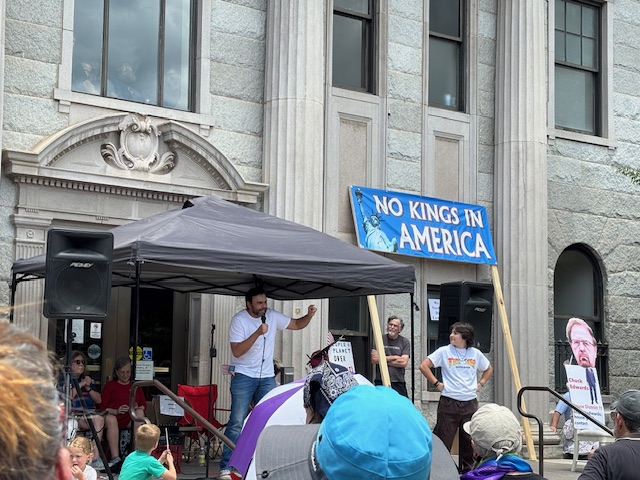
The author Andrew Aydin was spotted Saturday, June 14th at the “No Kings” rally in Waynesville, North Carolina, where he was the final speaker at its protest against authoritarianism. He will also be speaking this Tuesday, June 17th, at 6 p.m. at the Pigeon Community Cultural Center in Waynesville, NC, to introduce his Appalachia Comics Project.
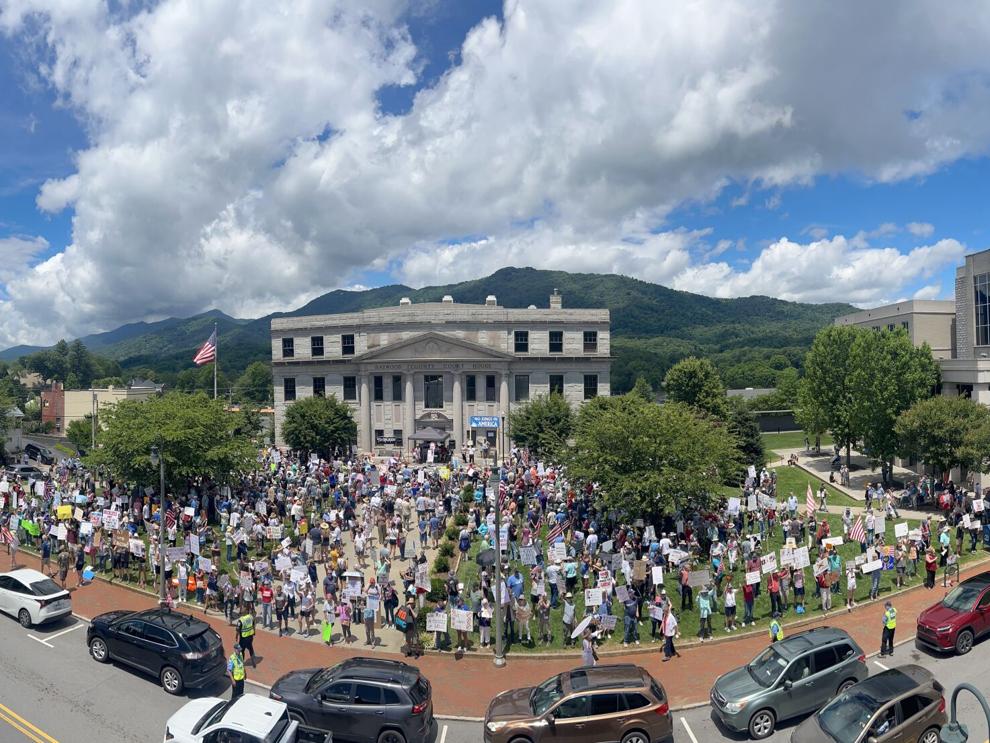
photo courtesy of Becky Johnson, The Mountaineer
A crowd of 1500-2,200 people – in a town of less than 11,000 residents and in a county (Haywood County) of less than 65,000 – gathered at the Waynesville courthouse at noon. Adjacent towns of Sylva, Asheville, Brevard, Hendersonville, and Bryson City held concurrent rallies. It was part of a day of about 2000 protests nationwide organized by No Kings; Waynesville’s protest was spearheaded by Hands Off! Hendersonville, which is affiliated with Indivisible. The king in the room (that is, at the courthouse) was the Trump Administration. No Kings website states: “They’ve defied our courts, deported Americans, disappeared people off the streets, attacked our civil rights, and slashed our services.” The protests coincided with the Administration’s $40-million military parade on Flag Day through the streets of Washington DC.

Aydin is co-author, with the late Georgia Congressman John Lewis and illustrator Nate Powell, of the March graphic memoir series on the civil rights movement. Book 3 of the series won the National Book Award in 2016 in the category of Young People’s Literature. Aydin, who served on John Lewis’s staff from 2007 to 2020, is now working on a series called Run about Lewis’s political career.
Aydin was fired up about misinformation about lack of federal aid for survivors of Hurricane Helene in Western North Carolina, which killed 107 people. The communities in Edneyville, Bat Cave, and Chimney Rock, near where he lives, he said, pulled together after the hurricane and benefitted from the support of the federal government, yet outside agitators spread the misinformation that they were getting no help at all:
Aydin’s anger motivated his new Appalachia Comic Project, which aims to capture authentic stories of Hurricane Helene survivors and disseminate them in comic-book form. According to Aydin, stories have unique power to assert values, counter lies, reclaim authenticity, and stand one’s ground.
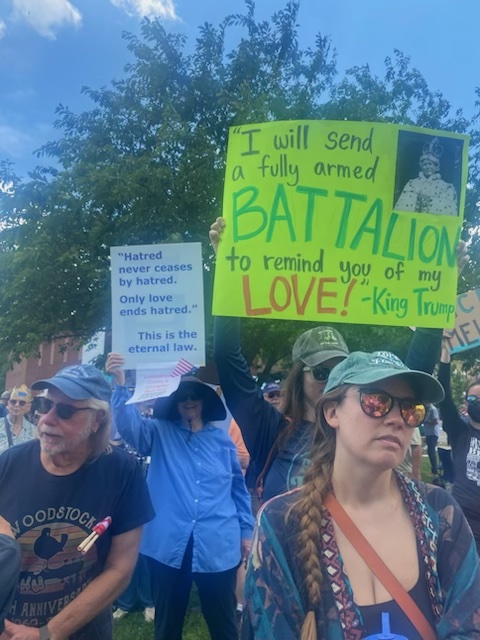
Aydin’s speech followed that of Stephen Wall, who read a letter by an anonymous civil service worker who had been fired; Lisa Leatherwood, who spoke of the expected Medicaid cuts to Haywood residents including those at the Silver Bluff Village skilled nursing home that she use to own; and Carolyn Carlson, former president of the Society of Professional Journalists, who warned that gag orders are compromising freedom of the press nationwide.
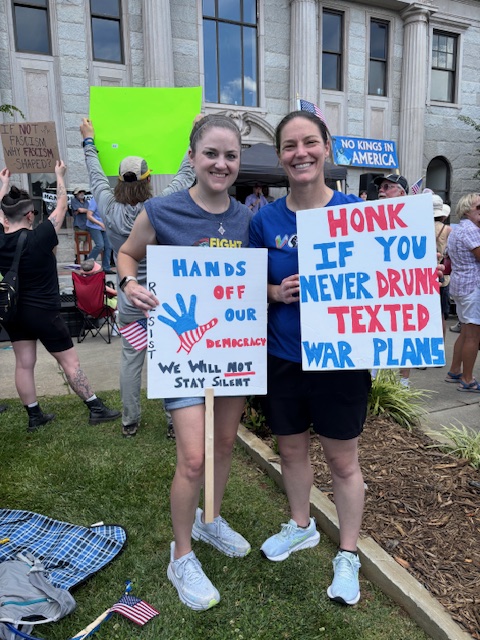
It was from Aydin that I heard about the political assassination of Minnesota Representative Melissa Hortman earlier that day, and the news unsettled me. Attendees trying to tune into the speeches also had to listen to a convoys of trucks with large flags spilling out the back driving down Main Street behind them, gunning engines, and attempting to drown out the speeches. We were instructed to counter any conflict with the chant “Bless Your Hearts.” I was near the stage and couldn’t hear specifically what the crowds bordering the street were chanting, but the relentless loud honking and gunning of engines was hard to ignore. Simultaneously a daylong “Spirit of America” fundraising event was being held by the Haywood County Republican Party in nearby Maggie Valley.

I was most impressed with Aydin’s articulation of how the political right is changing the meaning of language as we’ve known it. It is not hard to think of examples of such doublespeak. For me what comes to mind is the word “censorship.” To the right, censorship has come to mean objecting to a certain word or phrase and pressuring people to use another word or phrase (i.e., political correctness). Yet the actual definition of the word is “the action of preventing part or the whole of a book, movie, work of art, document, or other kind of communication from being seen or made available to the public, because it is considered to be offensive or harmful, or because it contains information that someone wishes to keep secret, often for political reasons.” To the left, censorship maintains its actual definition and means removing books as is being done in public school libraries so that no one can gain access to those writers, their stories and ideas; removing an entire field of knowledge, sociology, from the curriculum as was done at West Point Military Academy last semester; or forcing all publishers of science textbooks sold in Florida to remove the words “climate change” in an effort to suppress reality and the written record.

Andrew Aydin was a clever choice for a speaker on a day of national protests. His presence alluded to the marches on Selma, Alabama, in 1965 to secure voter rights for a vulnerable part of the population on a day when soldiers and tanks were being mobilized in Washington to show dominance and when the Marines and National Guard were watc on in Los Angeles. Aydin closed this way:
There is no sound more powerful than the marching feet of a determined people. So join us and let’s march, and take care of one another, and fight back. Because we are all we have. We are each others’ brothers and we are each others’ keepers and we are each others’ sisters and together we will build a more perfect union and build that city on the hill.
 LIT Alive!