Sidney Lanier’s The Marshes of Glynn comes alive in music
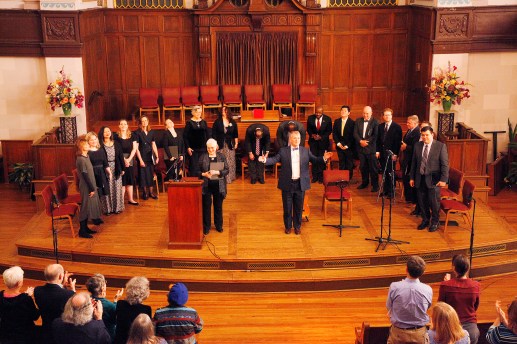
The Meridian Chorale performing in Southern Folk Passion, with Brenda Bynum on April 14, 2019 (photo courtesy of Meridian Herald)
(Updated March 2025)
I owe my budding awareness of the musician poet Sidney Lanier entirely to Meridian Herald’s Southern Folk Passion this past Palm Sunday at the Church at Ponce and Highland. But for stumbling upon Lanier on the group’s website before the concert, I might have always assumed that Lake Lanier and the other Lanier monikers around Atlanta were named for a great engineer or politician rather than a bard. Knowing that they are named after a poet laureate from Georgia, one who was commissioned as a southerner to write lyrics (along with Dudley Buck, a northerner, to write the music) for the cantata for the 100th anniversary of the United States in 1876, deepens my understanding of Georgia as a literary place. Continue reading Riotous noon-day sun of the June-day long
Robert Frank, “Charleston, South Carolina,” from Framing Shadows exhibit, photo of a photo
(Updated March 2025)
Kimberly Wallace-Sanders’ exhibit Framing Shadows at Emory University’s Robert W. Woodruff Library features 22 photos of African American nannies of white children from the 1840s to the 1920s, a family photo type found during these years in the eastern United States. It also displays novels that feature the mammy or nanny-child relationship such as Gone with the Wind, which Dr. Wallace-Sanders has written about in Mammy: A Century of Race, Gender, and Southern Memory. The juxtaposition shows a progression in Dr. Wallace-Sanders scholarship from the fictive mammy character in narratives, images, and artifacts to the real African American domestic servant taking care of white children in historical photos and biographical accounts. The exhibit previews her upcoming book on this work Nannies, Mammies, and Love Slaves: Portraits of Black Women Taking Care of White Children 1850-1950. Continue reading Not like one of the family
“Hank Aaron” white oak in Connally Nature Park, East Point
(Updated March 2025)
Last month I stumbled upon a memorial to “Big Al,” a massive willow oak on the Georgia Tech campus that spontaneously split and fell last autumn, shocking the community. Fall of a Champion was a student-produced exhibit on the more than 100-year-old tree that included benches, bookmarks, hinged wooden book covers, and coasters made out of Big Al, a poster that juxtaposed important events in the history of the university against dates of the rings in Big Al’s trunk, and paper meditations on arboreal life. After that event I got to thinking about how trees inspire communication. Continue reading In and around the oak
Restaurant at the corner of Peachtree Road NE and West Paces Ferry Road, Atlanta
(Updated March 2025)
What’s the first thing you think of when you hear the name Huckleberry Finn? It might be “floating down the Mississippi River on a raft,” or “friendship with Jim the runaway slave,” or maybe “smoking, cussing, fibbing… with a heart of gold,” or even “escaping ‘sivilization.’” Chances are you’re not going to say “food.” Continue reading Majestying in Buckhead
As Valentine’s Day looms, the thoughts of those so inclined naturally turn to one love classic above all, Shakespeare’s Romeo and Juliet. In this romantic tragedy, young lovers – Juliet is not even 14 years old! – from feuding families – the Montagues and the Capulets – unite but fail to bring their families together; they die from hate, misunderstanding, and bad timing.
Like many Americans I first encountered this passionate play in high school, and imagined myself to be on the balcony where “stony limits cannot hold love out.” The thrill was enhanced with exposure to the Franco Zeffirelli’s 1968 film adaptation. But amid government shut-downs, and from the vantage point of Atlanta, the national capital of the civil rights movement, I confess that these days my thoughts turn more to the steamy feuding of the Montagues and the Capulets than to the hot pheromonal yearning of Romeo and Juliet. Continue reading Where civil blood makes civil hands unclean
There’s something very wonderful about the coming of winter, cold, and darkness. It allows a person to burrow in, curl up with the dog or cat, bask in the warmth of the hearth, and read things like Ovid. Culturally it’s the Season of Light. Falling close to the winter solstice, the Season of Light marks the darkest part of the year. Winter celebrations involving light date from the Stone Age if not before. The Romans had two winter celebrations: Saturnalia, sometimes depicted as a festival of light leading to the winter solstice, and Sol Invictus, the festival of the sun God. Saturna, another pagan festival during the eight days up to the solstice, is depicted in the Jewish Talmud. The feast o Yule was celebrated by ancient Germanic peoples. Some of the old pagan rituals are similar to those in Christmas traditions. The Season of Winter, therefore, transcends any one religion or creed. So does most mythology, which is so distant in time and place from our world today. In reading it, you simply disconnect from the present time and watch the struggle of larger-than-life characters play out in your mind’s stage. You bring the stories back to our world.
House in December, Druid Hills, Atlanta
Ovid (43 BC-AD 17) rewrote Greek myths for a Roman audience. For example he retells the myth of Persephone as the myth of Proserpine (Book V), and it is a myth that explains winter. Continue reading Til it reaches the city of the sun
My mother used to read to us, but she never read us Uncle Remus. We weren’t from the South and also she hated dialect. I can understand. With dialect, a reader doesn’t just listen to the writer’s words but has to enact them in weird voices. Not everyone is up for that.
In anticipation of the anniversary of the 170th birthday of Joel Chandler Harris at the Wren’s Nest in Atlanta this December 9, I sat down with his Complete Tales of Uncle Remus (compiled by Richard Chase, 1983 [1955], 808 pages!) and went through the first book, Uncle Remus: His Songs and His Sayings, from Chapter 1 “Uncle Remus Initiates the Little Boy” to Chapter 32 “The Sad Fate of Mr. Fox.” Trying to read the regular silent way, the dialect was torturous. I sounded out phrases I couldn’t understand and figured some of them out – e.g., that “bimeby” means “by and by.” Eventually I gave up on silent reading. I started hearing an oral tale spoken by me.
Atlanta’s Little Women Collaborative Altered Book Project
(Updated March 2025)
A teaser: Which March sister does Louisa May Alcott refer to as Atlanta? (i.e., the huntress and sprinter in Greek mythology who agreed to marry any man who could outrun her, spearing those who couldn’t)***
This year is the sesquicentennial of Louisa May Alcott’s Little Women (1868), a book that is regarded, on the one hand, as a heart-warming tale of love, nuclear family, small-town community, and wholesome Christian goodness and a perfect read for the holiday season, or, on the other hand, as a pioneering work of distinct and independent female characters challenging the feminine norms of Civil War era society that continues to inspire girls in our own time to be strong and self-reliant, free spirited, unconventional and original. And a gamut in between. Sesquicentennial discussions and celebrations are happening all around the world, from the Alcott epicenter at Orchard House in Concord, MA, all the way to the Southern Hemisphere (see this compelling interview), from the pages of USA Today to those of the Paris Review. A sign the of book’s lasting popularity is that at the end of October Little Women was voted #8 of 100 best-loved American novels in The Great American Read.
Gary Shteyngart connects 1980s New York with contemporary Atlanta
(Updated March 2025)
The New Yorker doesn’t feature fiction set in Atlanta very often, but it did so this June with “The Luck of Kokura” by Gary Shteyngart. Barry Cohen, the protagonist of the story, is a hedge fund manager who flees a complicated life in Manhattan and probable insider trading charges, riding the “Hound” (Greyhound bus) to Atlanta and crashing the apartment of a former employee who lives there. “Crashing” captures the spontaneity but not the flavor of his stay, as the former employee Jeff Park lives in a “palatial” 4,000-square-foot luxury condo downtown with a “frigate-size couch” and a button-operated Lutron window shades, wears Lanvin sneakers ($500+) and a “seven-figure” Rolex watch, drives both a Ferrari California and a Bentley ($200,000+ apiece) and parks in special VIP zones for luxury cars. Barry’s own obsession with luxury watches seems the ultimate in conspicuous consumption in an era when time is incorporated into cell phones. Some Atlanta-New York comparisons seem odd (comparing the BeltLine to the High Line seems a stretch), but a focus on Atlanta’s money and ostentation seems right on. As does its focus on inequality, the haves and the have-nots, those who are lucky and those who are not.
$3490 cocktail dress, Tom Ford, Shops of Buckhead (Atlanta) $5.99 cocktail dress, Goodwill, Tucker (Atlanta)
Shteyngart’s opening reference to a Keith Haring painting hanging in Jeff Park’s Atlanta apartment and the premise of the financial trader in free fall immediately evoke the 1980s and, at least to me, the blockbuster novel that satirized that era, Tom Wolfe’s Bonfire of the Vanities (1987). Continue reading Atlanta and the Bonfire of the Vanities
A white American and a Nigerian read Jean Toomer’s Cane
Photo by John S. Quarterman for Okra Paradise Farms Berrien County GA, 2012, Licensed for reuse under Creative Commons.
(Updated December 2020 and March 2025)
I picked up Jean Toomer’s Cane (1923) to listen in on words from an old rural black Georgia that was still touched by slavery. What I found was an appreciation for black beauty.
The Norton Critical Reader edited by Rudolph P. Byrd and Henry Louis Gates Jr. informed me that Toomer was not an insider to old rural black Georgia culture. A mixed-race middle-class Washingtonian, Continue reading The last sweet scent of cane







 LIT Alive!