
Flannery O’Connor’s fervid following
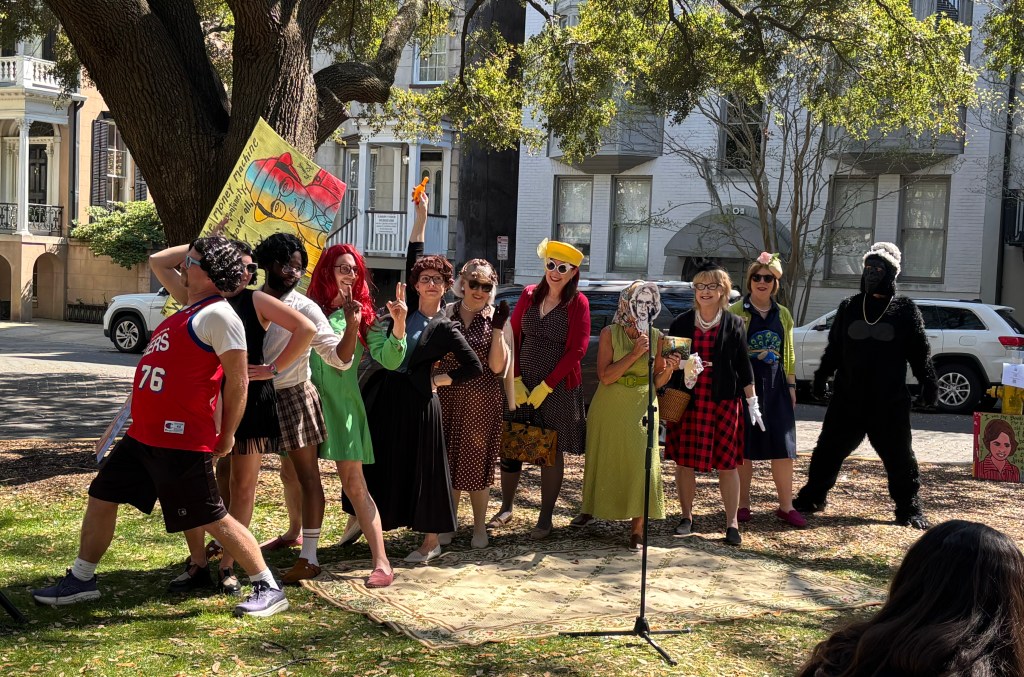
Flannery O’Connor (1925-1964) had her biggest-ever annual birthday celebration in Savannah, Georgia, last weekend, on the occasion of her 100th birthday. The Southern Gothic writer from Savannah was feted with three days of events, starting with soirées on Friday night and ending with a New Orleans-style procession through Lafayette Square led by Savannah’s Sweet Thunder Band late Sunday afternoon. It was a blast.
Flannery has always been an outsider, a Southerner in America, a devout Catholic in the Protestant South, a lupus patient walking with lofstrand crutches, and an unconventional female artist embracing the grotesque as a vehicle to convey the sublime. She explained her literary approach as a devout Catholic in “The Fiction Writer and His Country”: “to the hard of hearing you shout, and for the almost-blind you draw large and startling figures.” Academia never knew quite what to do with her and still doesn’t, especially considering her use of the n-word in her 1950s and 60s-era texts, as a person rooted in her geopolitical milieu. When I taught “Everything That Rises Must Converge” in the Honors College at Georgia State University recently, my students did not know who Flannery was. Yet it is clear from the weekend in Savannah that her following is alive and well – and growing – among seekers and artists.
Flannery O’Connor’s short stories juxtapose the grotesque in everyday circumstances against the ultimate mystery of human existence within a divine context. Her sentences astound with their sheer unpredictability, the journey from the beginning to the end of a sentence almost a short story in itself. Consider this sentence from “The Life You Save May Be Your Own” when the tramp from Tarwater, Tennessee, Tom T. Shiflet, takes out a pack of gum: “He offered the old woman a piece but she only raised her upper lip to indicate she had no teeth.” Or this one, later, after he lit a match for his cigarette against his shoe: “He held the burning match as if he were studying the mystery of flame while it traveled dangerously toward his skin.” We sense the epic, weighty, eternal dimension behind every word. Wake up!, the sentences seem to say. The destiny of your soul and the destiny of the world are at stake.
In her essay “The Grotesque in Southern Fiction,” Flannery wrote:
Whenever I’m asked why Southern writers particularly have a penchant for writing about freaks, I say it is because we are still able to recognize one. To be able to recognize a freak, you have to have some conception of the whole man, and in the South the general conception of man is still, in the main, theological.

The Friday night soirées took place at two different historic homes in Savannah, the Flannery O’Connor Childhood Home Museum on Lafayette Square and the Davenport House garden near Columbia Square. Attendees wore name tags noting their favorite work by O’Connor (among them “Revelation,” “Good Country People,” “Parker’s Back,” “A Temple of the Holy Ghost,” and Wise Blood), which prompted immediate conversation. I had interesting conversations with many members of the O’Connor Home Board of Directors, especially on the question of Why Flannery? Why now?
Bill Broker, a lawyer who comes to Flannery through his Catholicism, told me about the outpouring of Flannery-inspired music by Bruce Springsteen, U2, Colin Cutler, and many other musicians. Nancy Fullbright pointed to Ethan Hawke’s 2023 film Wildcat staring Maya Hawke and Laura Linney as popularizing some of her stories. Board president-elect Lee Griffith, professor of writing at Savannah College of Art and Design (SCAD), characterized Flannery as still contemporary in her exploration of many issues such as race and disability. Bonaventure Cemetery Director Sam Beetler II expressed Flannery’s quintessentially American quest to figure out her place (as a southerner, as a Catholic, etc.) within the larger world. Damon Mullins, executive director of the Ogeechee Riverkeeper, who was also in attendance, suggested that Flannery’s sheer weirdness and the weirdness of the annual birthday party in Lafayette Square was something that made Savannahians proud.

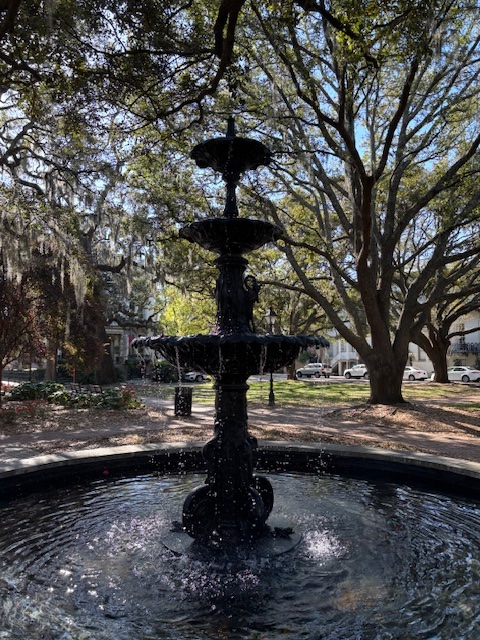
Festivities continued the next day with a tour of Lafayette Ward, the neighborhood surrounding Lafayette Square, which is grounded by The Cathedral Basilica of St. John the Baptist. From their modest house along this square, the O’Connors attended the cathedral daily. Our knowledgeable guide, board member Roger Smith, further illuminated Flannery’s judgment – she wrote with compassion, he said, for those around her who struggled to navigate life without Catholic doctrine.
Tours of the house and cathedral were also held throughout the day. A telling image from Flannery’s childhood home is her baby bassinette (“kiddie koop”) situated directly under the Cathedral’s spire.
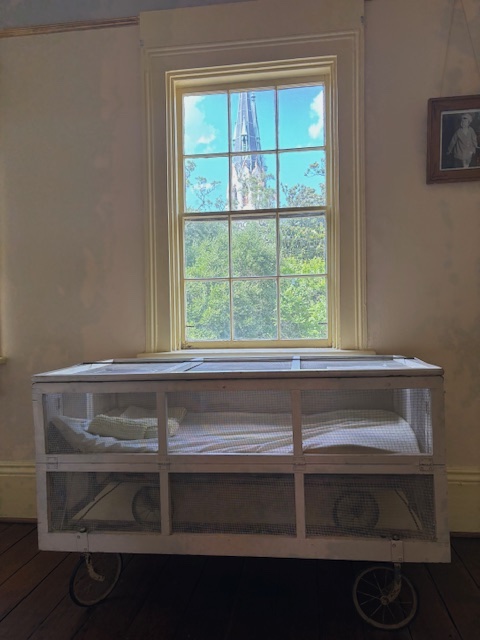
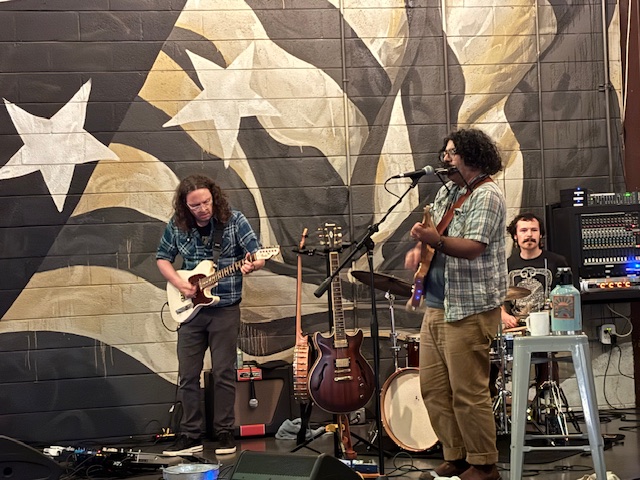
This detail was pointed out by the wonderfully engaging executive director of the Flannery O’Connor Childhood Home Museum, Janie Bragg, on her tour of the house, where Flannery lived until she was 13. Tours of the Cathedral were also provided throughout the day. The events on Saturday culminated in an evening concert fundraiser at Service Brewing near the Savannah River, where Colin Cutler and the Hot Pepper Jam Band performed songs from their Flannery-inspired album Tarwater.

Over sour beers while listening to Cutler’s “Bad Man’s Easy” among other songs, we discussed a 1959 recording of Flannery O’Connor reading “A Good Man is Hard to Find,” a thoroughly delightful rendition if you can decipher it (that’s a challenge). In this, one of her most famous stories, a grandmother, her son and his wife and children encounter the escaped criminal The Misfit on the backroads of Georgia.
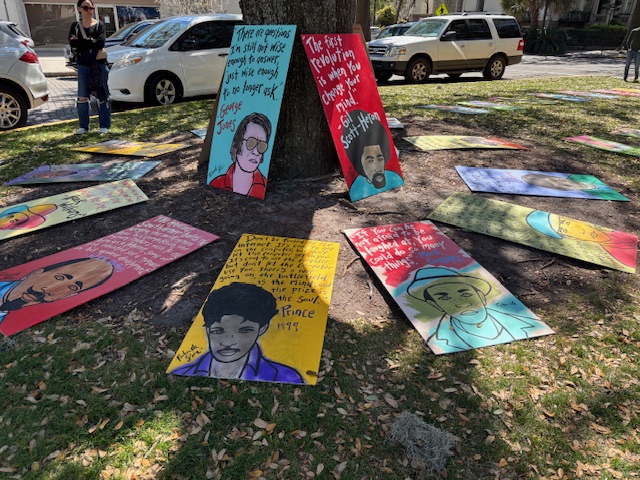
The party picked up again on Sunday at noon back on Lafayette Square, now strewn with an eye-catching display of paintings by the Savannah artist Panhandle Slim who has long been inspired by Flannery O’Connor. Slim paints on wooden placards, in the long tradition of Georgia outsider artists, faces and words of famous people. A number of placards were of Flannery O’Connor. On the other side of the square, local authors sold their latest books.
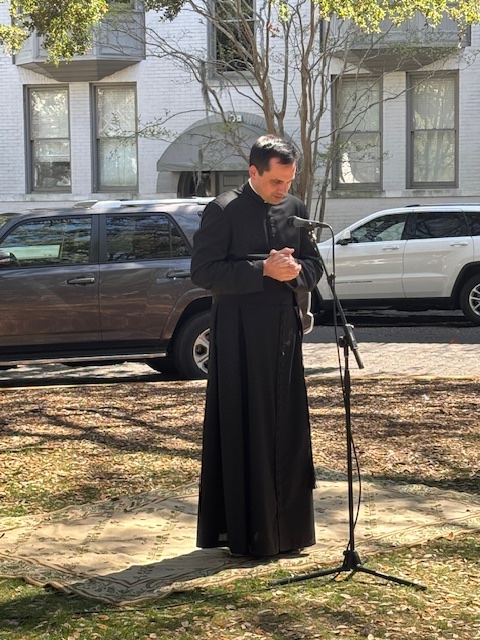
Father Drew Larkin from The Cathedral Basilica of St. John the Baptist offered a formal blessing. Entertainment included Irish step dancing, improvised opera by singers from Moon River Opera, the Flannery O’Connor look-alike contest, and a performance by Sweet Thunder Band.
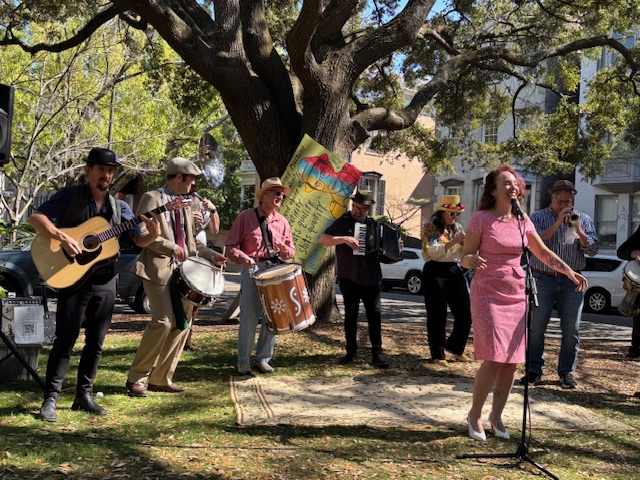
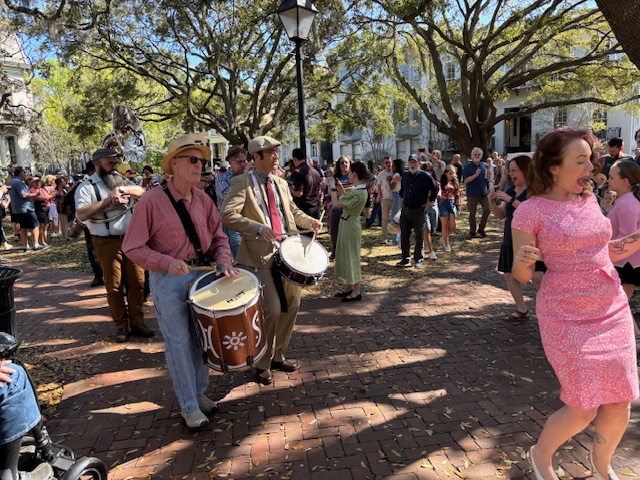
At the end of the day, Sweet Thunder Band spun out into the square and gathered people behind them in a dramatic sendoff. By that time, the large sheet cake had been eaten and new friends were saying goodbye.
Only a few days after this event in Savannah, festivities shifted north to Georgia College and State University in Milledgeville which now owns the Cline house where the O’Connors moved when Flannery was 14 and the family farm “Andalusia” where she lived with her lupus and peacocks in the last years of her life. The university unveiled a set of paintings by Flannery that never been on display before and that can be seen at Andalusia Interpretive Center through December 22, 2025. Their 100th birthday celebration of Flannery will take place on March 29.
Janie Bragg reflects on Flannery’s growing reach:
As things are being publicized, we’re having a Flannery moment. A good example is the art. The next example is her prayer journal that was published in 2013…so we are getting more and more not only books about Flannery O’Connor but of Flannery’s writing. Dear Regina was just published in 2023. Those are her letters to her mother…She’s so much more accessible now than she was before. And then that has all spurred things in the zeitgeist like Wildcat – that’s huge. Wildcat, not only is it a movie, so people who don’t like to read necessarily or don’t think of themselves as readers can come to Flannery through a different medium, but Ethan Hawke and his daughter Maya Hawke have a whole other audience than Flannery has, so they are bringing in all of these new people, these younger people, and that is very exciting. So I think her reach is spreading now in a way that it hadn’t before.
New research into the O’Connor’s black domestic help and farmhands at Andalusia will add other dimensions to Flannery’s complex story and milieu.
The Flannery O’Connor event is a great example of living, breathing literature. Come next March to enter the conversation and celebrate at Flannery’s 101st party.


What a thoroughly engaging piece!
LikeLike