
Harold Meltzer sets Aracelis Girmay’s poem “You Are Who I Love” for choir and percussion
In 2013 the composer Harold Meltzer was crossing Manhattan in a subway car when he saw Aracelis Girmay’s poem “Noche de Lluvia, San Salvador” on the wall as part of the Manhattan Transit Authority’s Poetry in Motion series; he copied it down word for word by hand, missing his stop. Three weeks later, across the Atlantic, he found himself with Girmay at the artist’s colony Civitella Ranieri. The poet recalled, “I was aware of this beautiful mind and spirit in the room. When I said I wrote poems, he did not look at me with grief and bewilderment.” Meltzer asked Girmay’s permission to set her poetry and years later it was her poem “You Are Who I Love” that he chose. The piece was commissioned by Elizabeth and Justus Schlichting for The Crossing and The Sandbox. This February 25, poet, poem, composition, and performers met up at the West Coast premiere at Stanford, where participants recounted these stories on stage. I crossed the US to attend.

The performance wasn’t the culmination of a simple trajectory but something much deeper and more personal. Girmay wrote “You Are Who I Love” for Split This Rock after Trump’s first presidential election in 2017. In 2019 Meltzer was in Rome en route again to Civitella Ranieri to work on the composition when he had a major stroke, followed by many smaller strokes over the next five years that would challenge his ability to move and work, but he continued even as he went in and out of care. As an old friend of his wife Hilary, I had the privilege of visiting him at Village Care in the spring of 2023 and seeing the score. That day he told many happy stories of his days playing bassoon and mentioned toying with the idea putting a “bicycle wheel” as a percussion instrument into the score. It sounded charming to me. Meltzer finished the piece in January 2024 and attended its premiere in Philadelphia in March; he died five months later. The Stanford concert, then, was a coming together of many friends and family in tribute to the composer on the West Coast. Although Girmay’s line venerating “You … crossing the desert and trying to cross the desert” alludes to immigrants attempting to cross out of danger and into safety, it could also speak to Harold’s long journey to cross the desert of his disease to bring forth what he considered his greatest musical achievement.
GIRMAY EXPLAINED, in a pre-concert talk, that the impetus for her poem was grief amidst the inauguration of Donald Trump in 2017: “The poem was really about learning to look in a different direction, to look elsewhere and to learn to look elsewhere.” The act of writing was a discipline of “turning my eye to who I love.” You can hear of the poet’s insights about this work here. A version of the poem is included in her 2025 poetry collection Green of All Heads.
The poet loves individual people going about daily activities, especially in care of others – “cheering the bees,” “delivering babies,” “reading your patients’ charts,” “carrying your brother home,” “sharing your potatoes and greens,” “braiding your child’s hair,” and “wanting to listen.” Her use of the continuous present puts the emphasis on people surviving, continuing, going about the important things in life, doing what they can, feeding love, not hate. In this long poem I counted 99 instances of continuous present verbs.
In Girmay’s reading at Stanford, the word “You” punctuated the air percussively, so that I walked away from all the individual details with the memory of the repeated “you” as the main point of the poem. The point of the poem is not I the speaker but you beyond me who I see and recognize as important. The echo of “who” with “you” throughout amplified coyly in my mind afterwards into a suggestion of “you-hoo” – I’m calling you, I see you, I’m reaching out, let’s connect, let’s cross over to each other and join together. I wonder if Bad Bunny took a page out of Girmay’s book a few weeks earlier in his unusually decentered Superbowl show.
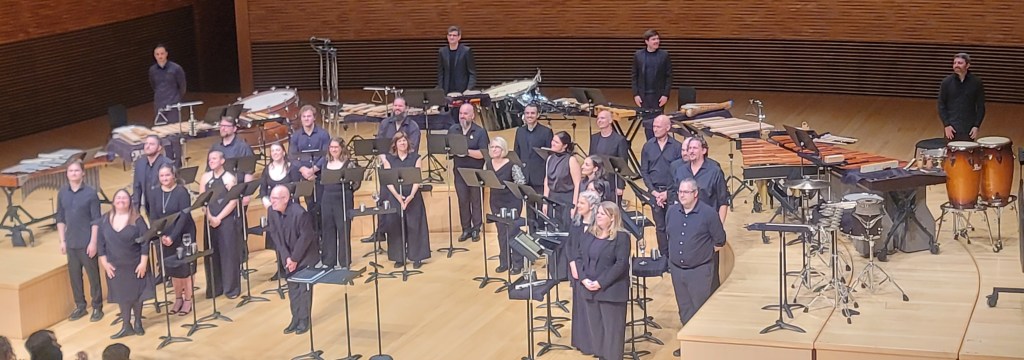
Bing Concert Hall, Stanford University (courtesy of Stanford Live)
The full 40-minute 2024 East-Coast-premiere version can be heard here, courtesy of The Crossing, which is currently working on a CD for future release.
MELTZER’S SCORE shows the choral and percussion parts stacked. On stage there were in fact four percussionists (playing about 100 percussion instruments total) standing in a wide horseshoe ring around approximately 25 choral singers who sang their parts solo or in groups.
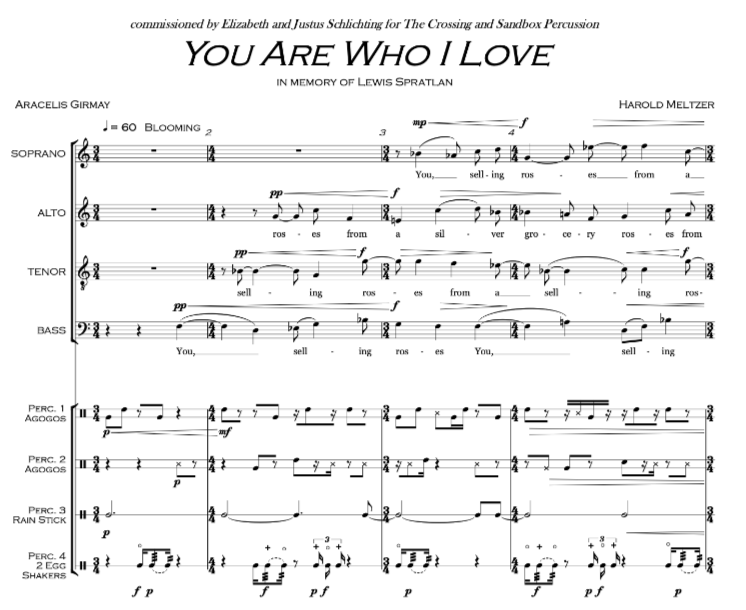
The score departs from the poem in looping back to certain passages from the beginning, each their own musical theme, namely:
1 – “You selling roses out of a silver grocery cart”
2 – “You, in the park, feeding the pigeons / You cheering for the bees”
3 – “You dancing in the kitchen, on the sidewalk in the subway waiting for the train because Stevie Wonder, Hector Lavoe La Lupe
4 – “Teaching your parents how to do The Dougie, counting to 10, reading your patients charts”
5 – “You struggling to see / You struggling to love or find a question”
The last loop back is about a third of the way through and then the work quickens and carries the poem straight through to the end.
The score features many directions: note the word BLOOMING on the opening score above, which returns at the end with a return to the opening musical theme. Most mysterious, near the end, are references to a “wall” (sound familiar from 2017-2020?): “THE WALL BEGINS TO COLLAPSE,” “THE COLLAPSE OF THE WALL CONTINUES,” and finally “ONE AT A TIME, THE PERCUSSIONISTS SIT AMONG THE FALLEN WOODEN PLANKS, HANDLING THEM IN A DESULTORY WAY.” Hilary told me that Meltzer’s original conception was to have the percussionists build a wall with their pitched wooden planks to silence the choir; too impractical to enact. Through the story of the wall, I came to see the percussionists and the singers at times in tension with each other. The most ardent passages, beginning about midway through the piece, are sung without percussion accompaniment, for example:
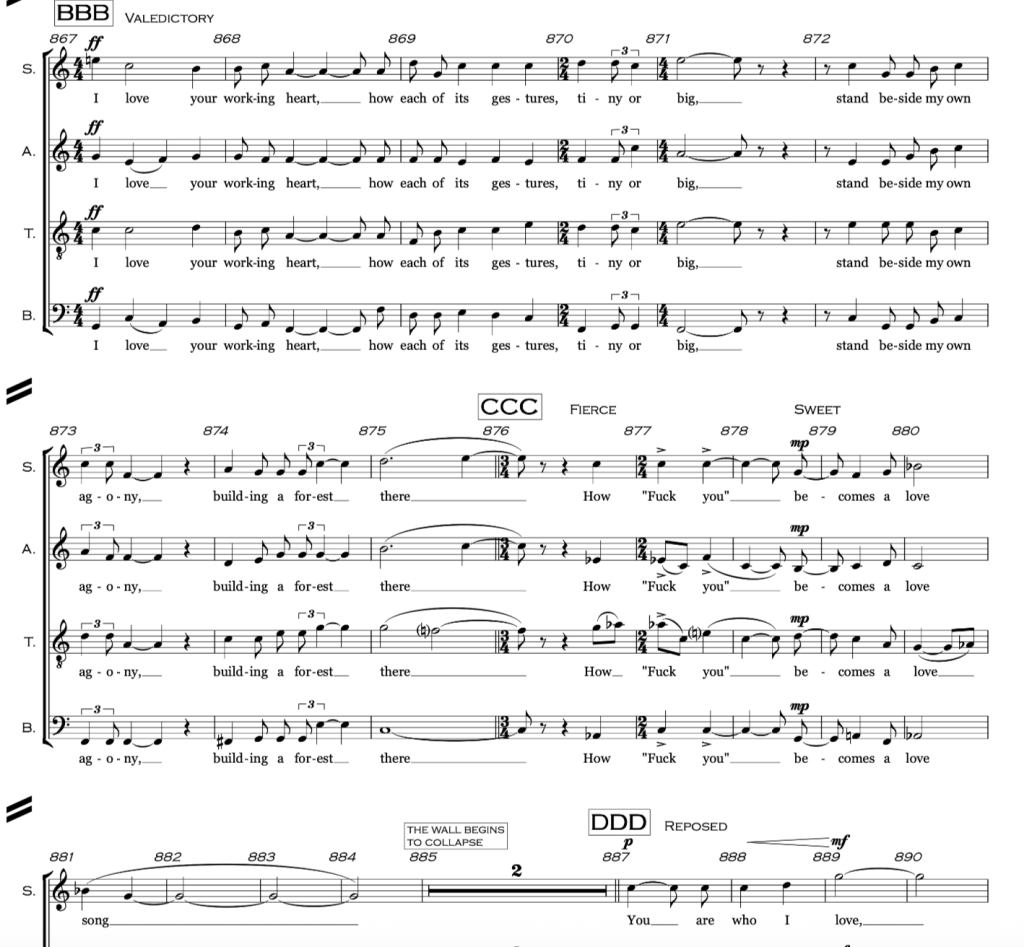
Meltzer directs this passage to be VALEDICTORY and sung in unison, whereas in other passages the lines from the poem are layered and sung simultaneously. This gorgeous passage, preceding the collapse of the wall, suggests that the people singing together is powerful enough to collapse the wall.
We should listen to all of this advice, from Aracelis Girmay’s original poem that models how to give attention to what we love rather than what we hate, to Meltzer’s musical work which amplifies and dramatizes a collective act of solidarity. As we cross a desert from one era to another, we need to make sure we carry what we love along with us or it may be lost forever.
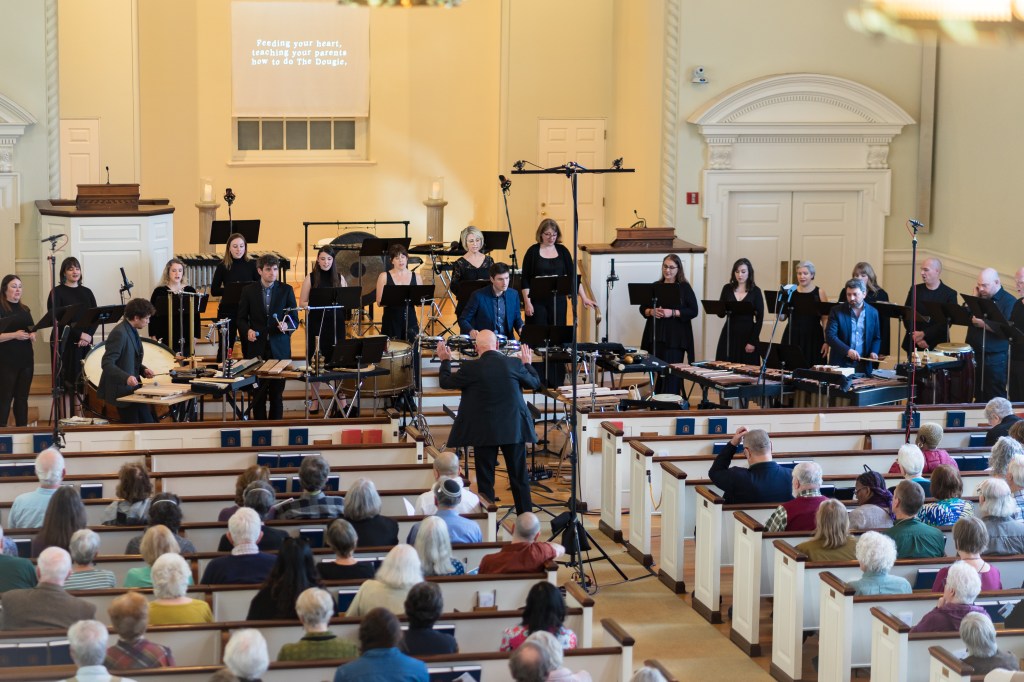
Presbyterian Church of Chestnut Hill, Philadelphia (courtesy of The Crossing)
More at lit-alive.com
 LIT Alive!