Dinner at Table & Main

William Faulkner & Susan Rebecca White join us

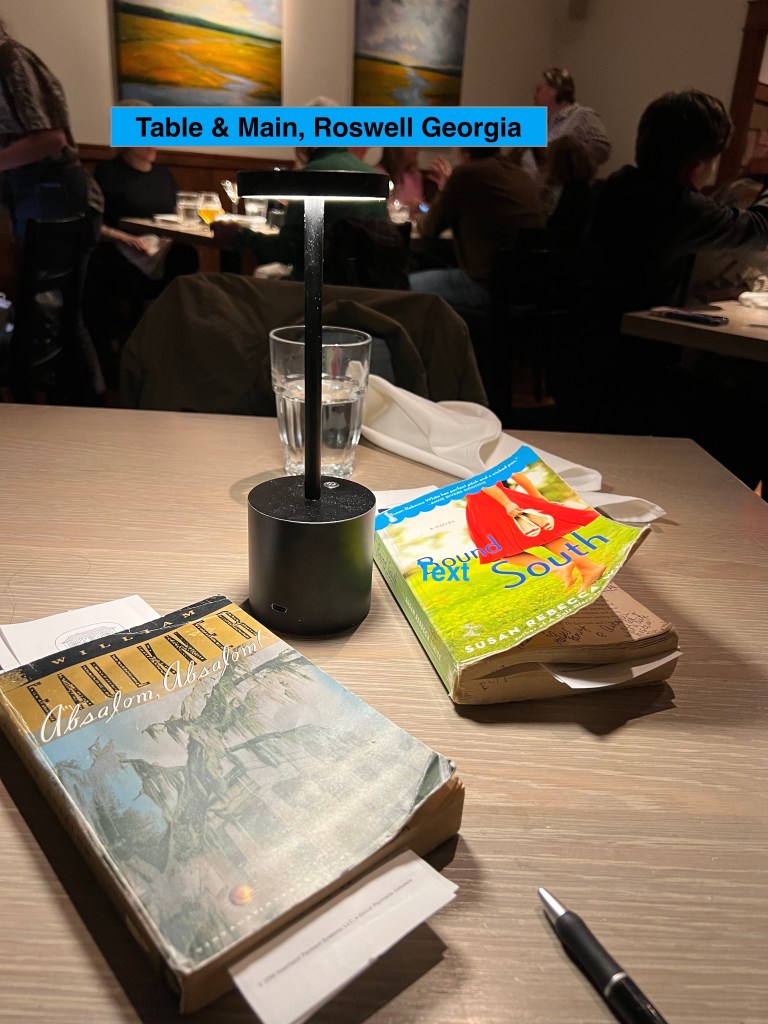
Not long ago I made an outing to Roswell, Georgia, with Parul Kapur (author of Inside the Mirror). We’d been going on literary outings OTP (outside the perimeter of Atlanta) but this one was just an outing.  We had a lovely walk along the Chattahoochee River, popped in at the consignment store Board of Trade, and landed for dinner at the esteemed restaurant Table & Main, where Parul wanted to go because of its Michelin Bib Gourmand designation. That’s why it was so surprising when after a delicious spread of meatloaf, shrimp & grits, the vegetable plate, and wine, and after a nice literary conversation, the checks arrived tucked inside southern novels. The restaurant’s owner-operator Ryan Pernice later explained the gesture: “We find it makes guests happy at what would otherwise be a low point. No one likes getting the bill!” 

Our dinner checks delivered in southern lit at Table & Main (courtesy Parul Kapur)

Parul’s check was inside Absalom Absalom! (1936) by William Faulkner, which she hadn’t read. Mine was inside Bound South (2009) by Susan Rebecca White, which I hadn’t read but which, aptly, Parul had once reviewed.

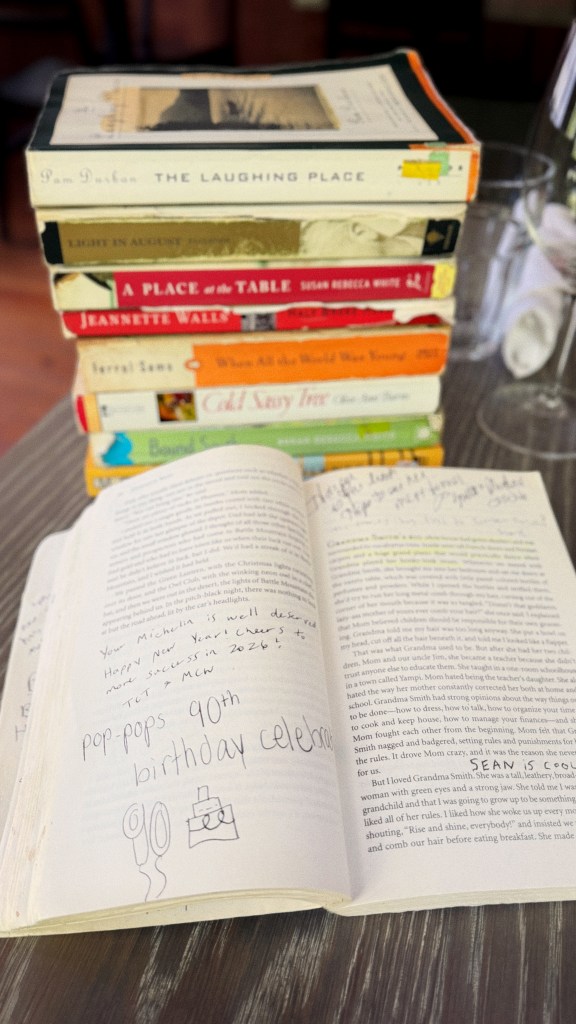
The books had some interesting comments written inside them by patrons at the restaurant. It turns out these “love notes” are a kind of tradition encouraged by the management.

Table & Main’s collection of southern lit, with an example of a “love note”
(courtesy of Ryan Pernice)

While someone else might see the delivery of checks inside books as just a novelty, I took it as an assignment! After all, it’s rare to take home substantive inspiration from a restaurant meal. I proposed to Parul that we each read the novels and have a conversation about them for this blog. She paused. “That would mean I’d have to read another book,” she reflected. As the 2025 winner of Georgia Author of the Year award for debut novel she was in the process of judging the 2026 nominees. “So no….” 

Instead I took the challenge myself and proceeded to read both books. And it was a challenge, as anyone who has tried to slog through Absalom Absalom! knows – 300 pages of dense prose from successive points of view slowly revealing the components of a convoluted plot, Biblical in scope – Quentin Compson’s story. In my college Faulkner course I’d thrown in the towel at Absalom Absalom! – I simply didn’t have the reference points, the literary maturity, or the understanding of how haunting legacies of the south are relevant today. It was so worthwhile to see the way it all comes together at the end, and I now am compelled to read it a second time to go deeper and also return to Faulkner’s The Sound and the Fury, a connected book. So thank you, Table & Main.

Pernice was impressed. “I don’t know that anyone would ever say that they were ‘delighted’ by Absalom Absalom!, and I applaud you for finishing it outside of college.” 

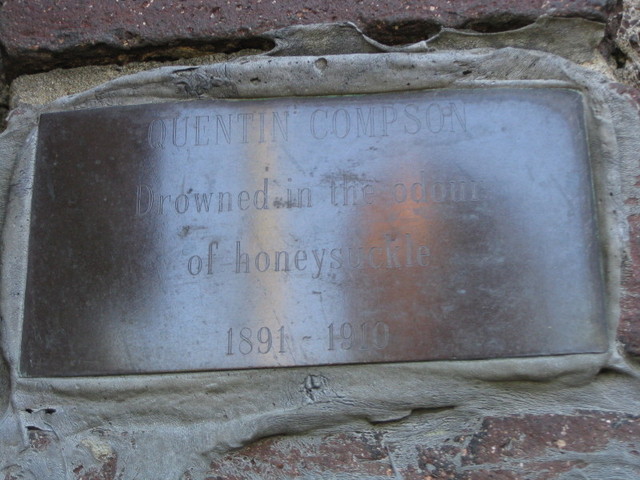
Another literary sighting can be had at the Anderson Bridge in Cambridge, Massachusetts at the place where Faulkner’s character Quentin Compson famously killed himself (in another Faulkner novel). The plaque reads, “QUENTIN COMPSON / Drowned in the odour of honeysuckle / 1891-1910” (public domain)

In a breach of etiquette I’m going to quote the book’s end, because honestly I see it more as a trailer than a spoiler for this now probably not-enough-read novel. The novel ends with Quentin’s damning words:

I don’t hate it [the South], he thought, panting in the cold air, the iron New England dark; I don’t. I don’t! I don’t hate it! I don’t hate it!

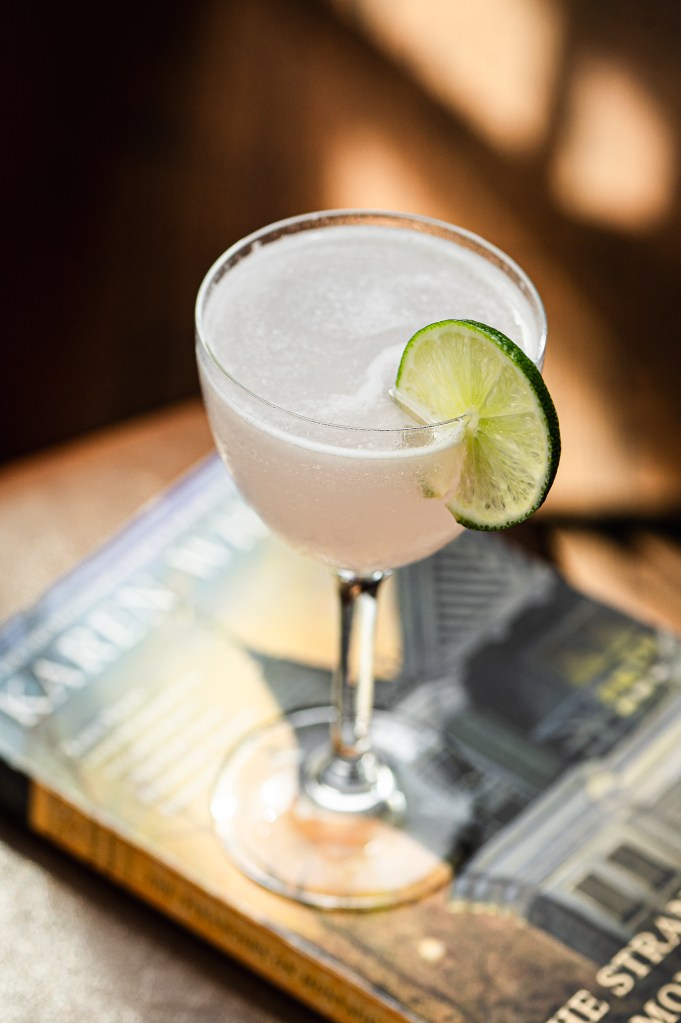
Sacred Harp Gimlet Cocktail at Table & Main (courtesy of Randi Curling)

More concretely, as a creative restaurateur, Pernice finds inspiration in the creation of Yoknapatawpha County, Mississippi, where many of Faulkner’s books are set:

What I love about his novels in relation to our restaurant is he created his own universe, that was very much based on facts but wasn’t a factual place … and so he’s another example of world building, where we talk in the restaurant a lot about every decision’s intentional, and every aspect of the art in the novel is intentional, and of course the food, the wine we choose, is all intentionally geared to make people feel a certain way in this world that we’ve created.

The beautiful interior of Table & Main (courtesy of Randi Curling)

After Absalom Absalom!, reading Bound Sound was a refreshing breeze. And, again, I have only the restaurant to thank for inspiring me to read the book. White’s humorous reckoning read like a primer on how to interpret white upper-class Atlanta. The novel speaks both to enduring customs (e.g., private schools, country clubs, black maids, keeping up appearances, glossing over the truth to maintain an illusion, and racial tension) and change (e.g., embracing gayness, outsider art, and a stint in San Francisco). I read many parts of Bound South aloud to my husband Les, and we laughed at the aptness of the references. Then Les asked if people would understand if they were not from Atlanta or had not lived there. Very good question.

I asked Pernice what he thought.

Well, isn’t that another hallmark of southern lit? There’s so many winks and nods to people who understand. To use a trope, the old southern ‘Bless her heart’: an author may write that and anyone not familiar with the south may take it at face value that they’re saying something kind when (in fact they aren’t). So it’s funny that southern lit has such a clubby mentality to it. 

I had a frisson of revelation. “Clubby” struck me the word I’ve been looking for ever since moving to Atlanta. Is southern lit clubby? That’s a very interesting question. But I do know that Atlanta and its environs are clubby. They run on clubs. And I’ve been asking around: Do others agree, is Atlanta a particularly clubby city? Yes, said the well-traveled Parul. Yes, said Les. Yes, I believe, said Susan Rebecca White. And yes, said others.

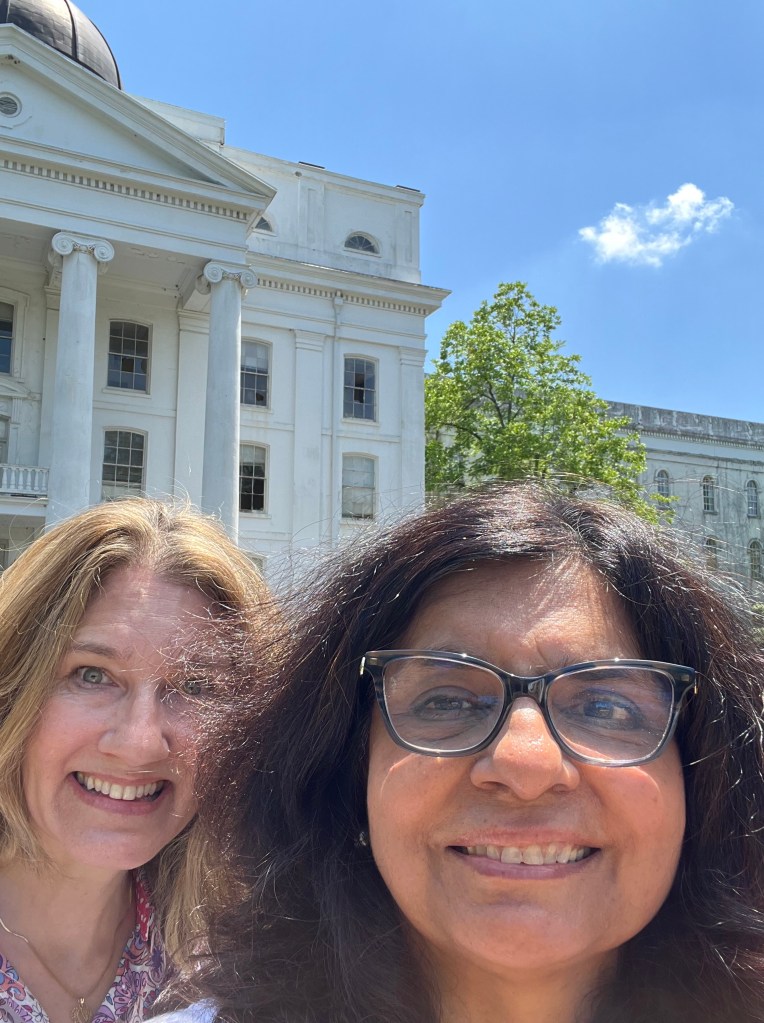
Ann & Parul on a literary outing to Milledgeville, GA (Flannery O’Connor country) 2025; at the ruins of the massive Central State (psychiatric) Hospital

I confess that clubby is perhaps my least favorite word. Where it might conjure to some the warm and cosy sense of belonging, to me it conjures the possibilities of exclusion. There is Atlanta’s old-money blue-blood club, for example, and then the many specific luxury golf and country clubs with entry fees ranging from $25,000 to $100,000+ with histories of excluding Blacks, Jew, and others. Tell me about a club and my first instinct is to run the other way.

So it was very interesting to me that when I asked Pernice what world he was building at Table & Main, he said:

I would describe it as simple seasonal southern. That’s our mantra there. Between that, which is our guiding north star, and the idea of creating the neighborhood clubhouse, which is a pretty Faulkner idea in and of itself, Table & Main was always supposed to be a gathering place by and for the community and I think we’ve delivered on that. At 15 years old I’m proud to see us come through with that vision. That’s our world, the neighborhood club house of Roswell. 

Here “club house” I think suggests a fun, not-too-fancy local gathering spot for people to come back to time and time again. I think that Pernice means “club house” in the best possible sense of the word. It made me think deeper. Want to or not, we all belong to clubs. There is the zip code club. The job club. Going to college has become an elite club. Zodiac signs and Myers-Briggs personality types are clubs, not to mention sports teams. To set about building a world that welcomes all is a mighty aspiration in our present world. And indeed, Parul and I felt completely comfortable and happy lingering at this lovely restaurant. I went home with an assignment and ended up with a better understanding of the south.

Bourbon Sweet Potato Cake at Table & Main (courtesy of Randi Curling)

More at LIT Alive!

Crossings

Harold Meltzer sets Aracelis Girmay’s poem “You Are Who I Love” for choir and percussion

In 2013 the composer Harold Meltzer was crossing Manhattan in a subway car when he saw Aracelis Girmay’s poem “Noche de Lluvia, San Salvador” on the  wall as part of the Manhattan Transit Authority’s Poetry in Motion series; he copied it down word for word by hand, missing his stop. Three weeks later, across the Atlantic, he found himself with Girmay at the artist’s colony Civitella Ranieri. The poet recalled, “I was aware of this beautiful mind and spirit in the room. When I said I wrote poems, he did not look at me with grief and bewilderment.” Meltzer asked Girmay’s permission to set her poetry and years later it was her poem “You Are Who I Love” that he chose. The piece was commissioned by Elizabeth and Justus Schlichting for The Crossing and The Sandbox. This February 25, poet, poem, composition, and performers met up at the West Coast premiere at Stanford, where participants recounted these stories on stage. I crossed the US to attend. 

Harold Meltzer, August 2024 (courtesy of Hilary Meltzer)

The performance wasn’t the culmination of a simple trajectory but something much deeper and more personal. Girmay wrote “You Are Who I Love” for Split This Rock after Trump’s first presidential election in 2017. In 2019 Meltzer was in Rome en route again to Civitella Ranieri to work on the composition when he had a major stroke, followed by many smaller strokes over the next five years that would challenge his ability to move and work, but he continued even as he went in and out of care. As an old friend of his wife Hilary, I had the privilege of visiting him at Village Care in the spring of 2023 and seeing the score. That day he told many happy stories of his days playing bassoon and mentioned toying with the idea putting a “bicycle wheel” as a percussion instrument into the score. It sounded charming to me. Meltzer finished the piece in January 2024 and attended its premiere in Philadelphia in March; he died five months later. The Stanford concert, then, was a coming together of many friends and family in tribute to the composer on the West Coast. Although Girmay’s line venerating “You … crossing the desert and trying to cross the desert” alludes to immigrants attempting to cross out of danger and into safety, it could also speak to Harold’s long journey to cross the desert of his disease to bring forth what he considered his greatest musical achievement.  

GIRMAY EXPLAINED, in a pre-concert talk, that the impetus for her poem was grief amidst the inauguration of Donald Trump in 2017: “The poem was really about learning to look in a different direction, to look elsewhere and to learn to look elsewhere.” The act of writing was a discipline of “turning my eye to who I love.” You can hear of the poet’s insights about this work here. A version of the poem is included in her 2025 poetry collection Green of All Heads.

The poet loves individual people going about daily activities, especially in care of others – “cheering the bees,” “delivering babies,” “reading your patients’ charts,” “carrying your brother home,” “sharing your potatoes and greens,” “braiding your child’s hair,” and “wanting to listen.” Her use of the continuous present puts the emphasis on people surviving, continuing, going about the important things in life, doing what they can, feeding love, not hate. In this long poem I counted 99 instances of continuous present verbs.

In Girmay’s reading at Stanford, the word “You” punctuated the air percussively, so that I walked away from all the individual details with the memory of the repeated “you” as the main point of the poem. The point of the poem is not I the speaker but you beyond me who I see and recognize as important. The echo of “who” with “you” throughout amplified coyly in my mind afterwards into a suggestion of “you-hoo” – I’m calling you, I see you, I’m reaching out, let’s connect, let’s cross over to each other and join together. I wonder if Bad Bunny took a page out of Girmay’s book a few weeks earlier in his unusually decentered Superbowl show.

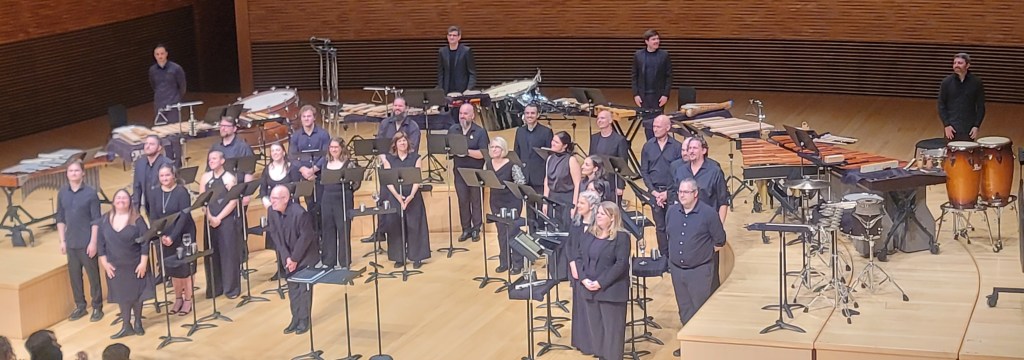
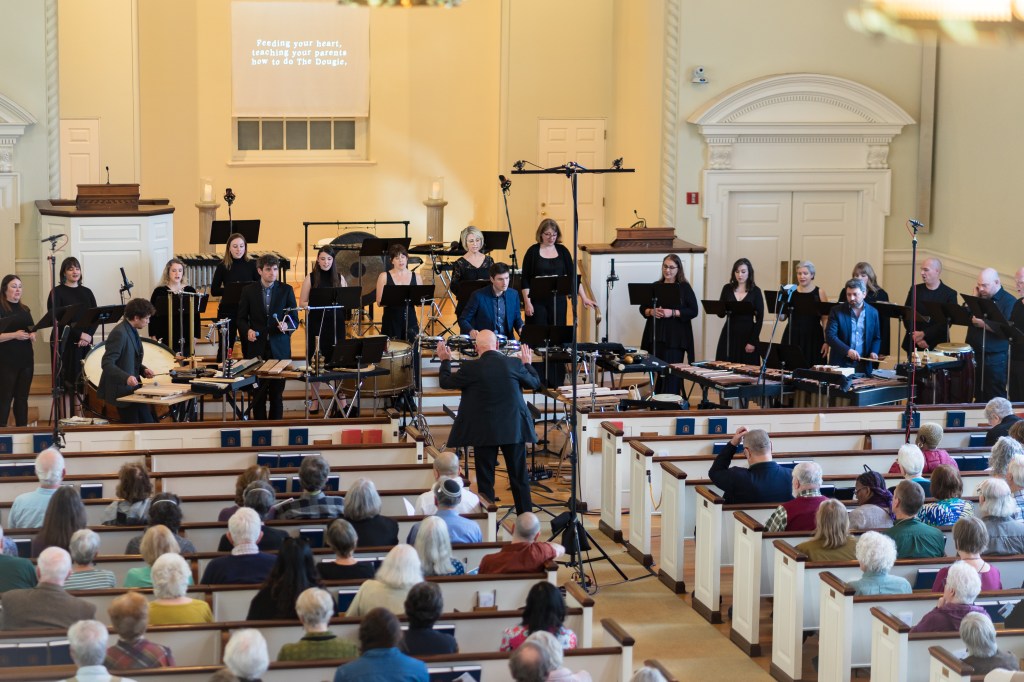
The Crossing and The Sandbox following the February 25, 2026 concert,
Bing Concert Hall, Stanford University (courtesy of Stanford Live)

The full 40-minute 2024 East-Coast-premiere version can be heard here, courtesy of The Crossing, which is currently working on a CD for future release.

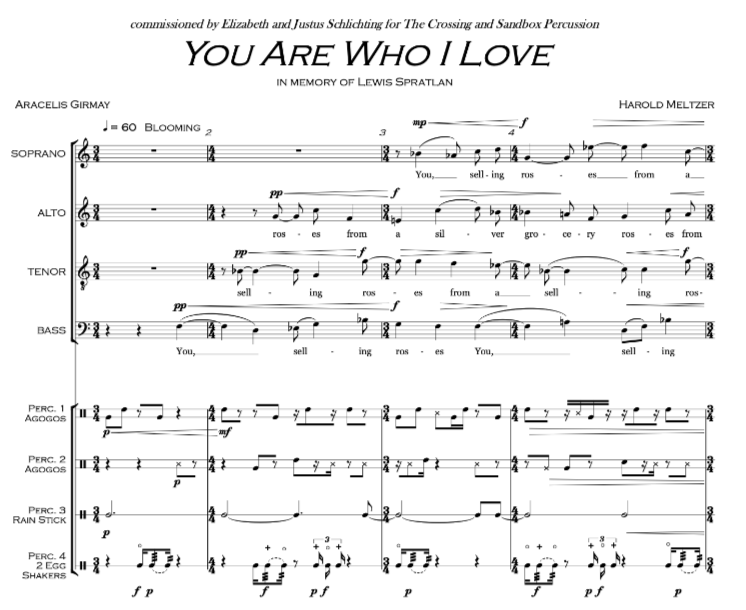
MELTZER’S SCORE shows the choral and percussion parts stacked. On stage there were in fact four percussionists (playing about 100 percussion instruments total) standing in a wide horseshoe ring around approximately 25 choral singers who sang their parts solo or in groups.

First system of Meltzer’s composition (courtesy of Hilary Meltzer)

The score departs from the poem in looping back to certain passages from the beginning, each their own musical theme, namely:

1 – “You selling roses out of a silver grocery cart”

2 – “You, in the park, feeding the pigeons / You cheering for the bees”

3 – “You dancing in the kitchen, on the sidewalk in the subway waiting for the train because Stevie Wonder, Hector Lavoe  La Lupe

4 – “Teaching your parents how to do The Dougie, counting to 10, reading your patients charts”

5 – “You struggling to see / You struggling to love or find a question”

The last loop back is about a third of the way through and then the work quickens and carries the poem straight through to the end.

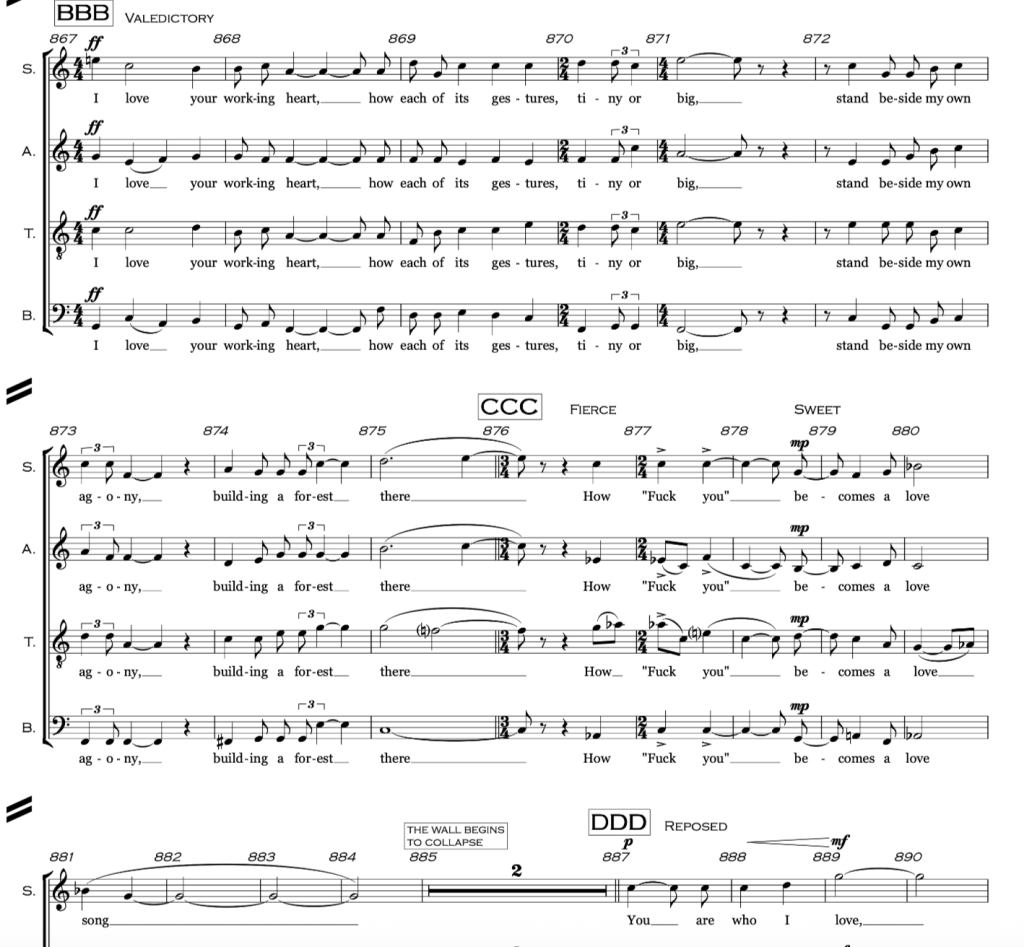
The score features many directions: note the word BLOOMING on the opening score above, which returns at the end with a return to the opening musical theme.  Most mysterious, near the end, are references to a “wall” (sound familiar from 2017-2020?): “THE WALL BEGINS TO COLLAPSE,” “THE COLLAPSE OF THE WALL CONTINUES,” and finally “ONE AT A TIME, THE PERCUSSIONISTS SIT AMONG THE FALLEN WOODEN PLANKS, HANDLING THEM IN A DESULTORY WAY.” Hilary told me that Meltzer’s original conception was to have the percussionists build a wall with their pitched wooden planks to silence the choir; too impractical to enact. Through the story of the wall, I came to see the percussionists and the singers at times in tension with each other. The most ardent passages, beginning about midway through the piece, are sung without percussion accompaniment, for example:

Excerpt from Meltzer’s score (courtesy of Hilary Meltzer)

Meltzer directs this passage to be VALEDICTORY and sung in unison, whereas in other passages the lines from the poem are layered and sung simultaneously. This gorgeous passage, preceding the collapse of the wall, suggests that the people singing together is powerful enough to collapse the wall.

We should listen to all of this advice, from Aracelis Girmay’s original poem that models how to give attention to what we love rather than what we hate, to Meltzer’s musical work which amplifies and dramatizes a collective act of solidarity. As we cross a desert from one era to another, we need to make sure we carry what we love along with us or it may be lost forever.  

The Premiere of Meltzer’s “You Are Who I Love” in March 2024 at the
Presbyterian Church of Chestnut Hill, Philadelphia (courtesy of The Crossing)

More at lit-alive.com

A Chaos of Nonconformity

Ian McEwan joins a debate about the novel’s impact today

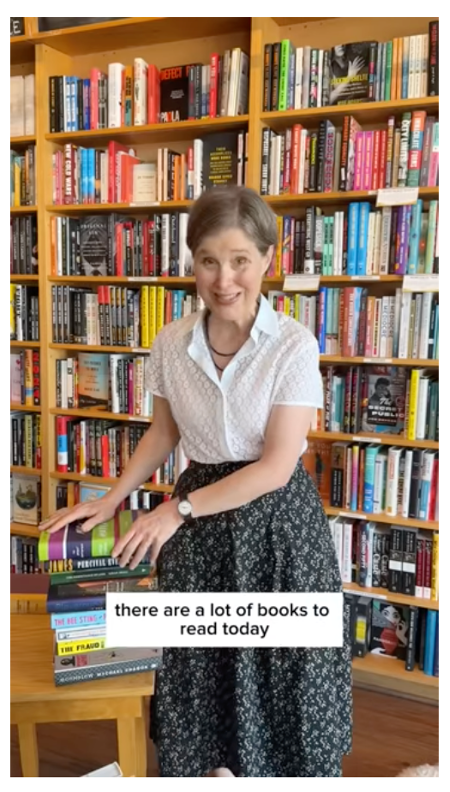
Screen shot of novelist Ann Patchett at Parnassus Books, Nashville, TN,
delivering News to You: Literature Isn’t Dead

A few months ago, a friend texted me News to You: Literature Isn’t Dead, Ann Patchett’s impassioned defense of literary fiction’s centrality to American culture today. The novelist, who runs the bookstore Parnassus in Nashville, Tennessee, was responding to an op-ed in the New York Times by the conservative political commentator David Brooks called When Novels Mattered about a period in American history ending in the 1980s when, he claims, literary authors were audacious, big in scope, unconstrained by political correctness and liberal conformity, and therefore actually mattered to the culture – unlike now.

Patchett hit back with 15 titles that she considers audacious and significant to culture today. They are (with my annotations added on when they were published and when they were set):

Continue reading A Chaos of Nonconformity

Shiloh: A Requiem (April, 1862)

Margaret Vetare, Herman Melville, and WNYC’s Public Song Project

Margaret Vetare at West Point Foundry Preserve, Cold Spring, New York, USA (photo by Susan English)

In May the singer-songwriter Margaret Vetare, a college friend, told me that she’d submitted a song to WNYC’s “Public Song Project” which showcases new recordings of songs made from works in the American public domain. The songs can be based on poems, books, films, existing songs, and even fictional characters. The Project announced six winners at the end of July and performed them on August 2 in front of the Brooklyn Public Library in New York City. All songs can be streamed from the “Public Song Book” online.  

Simon Close, the creator of the Public Song Project for public radio station WNYC, introduced the project’s mission and ethos in a radio special he emceed on July 26th:

Continue reading Shiloh: A Requiem (April, 1862)