A Chaos of Nonconformity

Ian McEwan joins a debate about the novel’s impact today

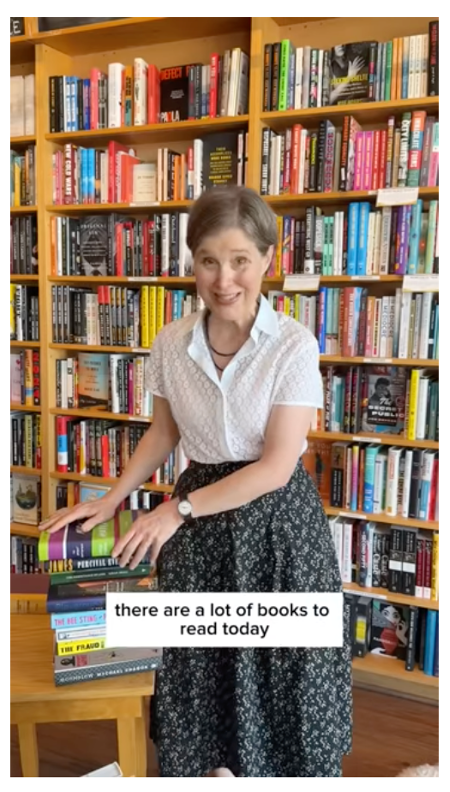
Screen shot of novelist Ann Patchett at Parnassus Books, Nashville, TN,
delivering News to You: Literature Isn’t Dead

A few months ago, a friend texted me News to You: Literature Isn’t Dead, Ann Patchett’s impassioned defense of literary fiction’s centrality to American culture today. The novelist, who runs the bookstore Parnassus in Nashville, Tennessee, was responding to an op-ed in the New York Times by the conservative political commentator David Brooks called When Novels Mattered about a period in American history ending in the 1980s when, he claims, literary authors were audacious, big in scope, unconstrained by political correctness and liberal conformity, and therefore actually mattered to the culture – unlike now.

Patchett hit back with 15 titles that she considers audacious and significant to culture today. They are (with my annotations added on when they were published and when they were set):

  • The Night Watchman (2021) by American author Louise Erdrich – set in the 1950s
  • James (2024) by American author Percival Everett – set in the 1840s
  • Inheritance of Loss (2006) by Indian author Kiran Desai – set in India in the 1980s 
  • The Overstory (2018) by American author Richard Powers – set from the 1880s to the present 
  • Playground (2024) by American author Richard Powers – set now and in near future
  • Native Speaker (1995) by American author Chang-Rae Lee – set during the 1990s
  • The Bee Sting (2023) by Irish author Paul Murray – set now
  • Demon Copperhead (2022) by American author Barbara Kingsolver – set in the 1990s
  • The Fraud (2023) by British author Zadie Smith – set in the late 1800s
  • What is the What (2006) by American author Dave Eggers (in conjunction with a lost boy of Sudan Valentino Achek Deng) – set in the early 2000s
  • Moonglow (2016) by American author Michael Chabon – set in the 1980s and before
  • Harlem Shuffle (2021) by American author Colson Whitehead – set in the 1950s and 1960s
  • Crook Manifesto (2023) by American author Colson Whitehead – set in 1970s
  • The Goldfinch (2013) by American author Donna Tartt – set in the early 2000s
  • Lush Life (2008) by American author Richard Price – set in the early 2000s

I was interested in when Patchett’s recommended books were set because, although Brooks is very unclear, I infer that he is looking for social realist fiction about the here and now representing a swathe of social classes and races, with explosive conflict and perhaps satire – along the lines of Tom Wolfe’s Bonfire of the Vanities (1987) which he admires. According to those criteria, only three of Patchett’s recommendations would meet that mark: the Jim Powers novels (Overstory and Playground) and Paul Murray’s The Bee Sting.

David Brooks, 2022, Public Domain 

David Brook’s own list of works that mattered in the past is undisciplined and sprawling,  conflating a number of criteria:

  • 1) bestseller status (who appeared on Publishers Weekly’s annual list of top 10 bestsellers in the US as an indicator of impact – e.g., Lolita by Vladimir Nabokov in 1958, Dr. Zhivago by Boris Pasternak in 1969, Portnoy’s Complaint by Philip Roth in 1969, and Ragtime by E. L. Doctorow in 1975).
  • 2) celebrity status (who appeared in the tabloids – e.g., Gore Vidal, Norman Mailer, Truman Capote)
  • 3) era and geography (who was from the Anglosphere anytime from the 18th through the 20th century – e.g., F. Scott Fitzgerald, William Faulkner, George Eliot, Jane Austen, or David Foster Wallace), and
  • 4) audacity (who bucks tradition – e.g., The Bluest Eye by Toni Morrison, Gravity’s Rainbow by Thomas Pynchon, and Humboldt’s Gift by Saul Bellow, as well as Edith Wharton, Mark Twain and James Baldwin).

I fact-checked one of Brooks’s claims, that not a single work of literary fiction has appeared on the Publishers Weekly’s annual list of top 10 bestsellers in the US since  The Corrections by Jonathan Franzen in 2001, and Brooks came up short.  In fact, another work by Jonathan Franzen, Freedom, appeared on that list in 2010. If Wikipedia’s entry on the subject is accurate, since 2001 the following literary works have also appeared on the Publishers Weekly annual list:

  • 2002 and 2003: The Lovely Bones (2002) by American author Alice Sebold (who, by the way, achieved much lurid celebrity notoriety on the scale of Normal Mailer) – set in the 1970s 
  • 2005: The Mermaid Chair (2005) by American author Sue Monk Kidd – set in late 1980s
  • 2007: A Thousand Splendid Suns (2007) by Afghan-American author Khaled Hosseini – set in 1960s to early 2000s Afghanistan
  • 2008: The Story of Edgar Sawtelle by American author David Wroblewski – set in the 1970s
  • 2010: Freedom (2010) by American author Jonathan Franzen – set in 1980s to present
  • 2013: The Great Gatsby (2025) by the late American author F. Scott Fitzgerald – set in 1920s
  • 2015: Go Set a Watchman (2015) by the late American author Harper Lee – set in the 1930s 
  • 2015: To Kill a Mockingbird (1960) by tbe late American author Harper Lee – set in the 1950s
  • 2016: All the Light We Cannot See (2016) by American author Anthony Doerr – set in 1940s France
  • 2020: Little Fires Everywhere (2017) by American author Celeste Ng – set in 1990s
  • 2021: The Song of Achilles by American author Madeline Miller – set in ancient times during the Trojan War

These oversights might be explained by Brooks’ dismissing the classics as unimportant reruns as well as ignoring any work that is even slightly historical. However, some of the novels on his own lists are backward-facing too. I think the reason Brooks misses Jonathan Franzen’s second best selling book in 2010 is because he is not reading the lists himself; he is, it seems, lazy.

Many people I know believe that the times we are living in can best be understood through consideration of the past, historical fiction. Though this Lit Alive! blog is about literary sightings that come at me, my favorite literary genre is, in fact, the opposite of historical fiction — I prefer novels set in the near future or with alternative presents that show us where our culture might be headed. There is nothing timid or conformist about considering the effects of climate change and technology, and my list of big audacious works that have had impact would include at least the following: 

  • The Circle (2013) by American author Dave Eggers – set in the unspecified near future
  • The Children’s Bible (2020) by American author Lydia Millet – set in the present or near future
  • Klara and the Sun (2021) by British author Kazuo Ishiguro – set in the unspecified future
  • Prophet Song (2023) by Irish author Paul Lynch – set in an alternative Ireland today or in the near future
  • What We Can Know (2025) by British author Ian McEwan – set in 2120. 
Ian McEwan, photo by Tim Duncan, 2025, Edinburgh International Book Festival, Creative Commons Attribution-Share Alike 4.0 International license.

Ian McEwan, whose futuristic literary thriller of sorts What We Can Know just came out in September, seems to respond directly to Brooks through the literary mouthpieces that inhabit the book. McEwan considers the future legacy of our current information age and directly comments on the controversy of how novels matter today.

In this novel, literary scholar Tom Metcalfe is searching for a lost unpublished poem (“corona for Vivien”) written by a famous poet to his wife that has achieved mythic status in the 100-some years since its reading at a party in 2014. In the 22nd century, everything once in the cloud is now data managed by the Nigerians and freely available to everyone; the US is mostly out of bounds because it is controlled by warlords; use of the Bodleian Library at the University of Oxford requires boat trips because Britain is now an archipelago; and AI is now injected in dosages. In combing through the archives from our present era, Metcalfe constructs the biography of the poem’s creation only to later learn that based on this evidence he is wrong about almost everything.

On the way to the finale, the scholar Vivien Blundy, wife of the famous poet, decides to leave her academic humanities position, lamenting “our old centrality to the culture gone.” However, Tom describes the historic period of “The Derangement” (2015-2030), from his 22nd century vantage point this way:

The times were copious, like rivers in spate. Its teeming hoards of novelists, poets and dramatists formed a giant army massed against its readers, who were never quite sure of what was good. So the arguments were insecure and loud, and that was fine, a democracy of contesting tastes, a chaos of unconformity. 

In contrast to our times, the characters live in the isolation of the little islands which kill diversity and in fact everyone in this era has become the same shade of light brown. Tom comes to agree with his colleague Rose that “the Derangement could not have been addressed by fictional realism. It was inadequate to the scale of the problem.” It seems that McEwan disagrees with Brooks that we especially need social realist novels.

McEwan’s voice, through his protagonist, suggests that our times are still ok in terms of literary output, and our problem is not that we have a great quashed conformity of voices from writers going through MFA programs in the liberal university system, as Brooks asserts. Instead, a great many voices that were formally suppressed have suddenly arrived through opened gates all at the same time and now they struggle to be heard – and us readers struggle to keep up. The quantity and lack of focus may be challenging, indeed off-putting, to would-be readers. It’s understandable.

People on phones. https://pxhere.com/en/photo/1432547 CC0 Public Domain
I’m not sure they’re reading literary fiction.

To state the obvious, writers today are also competing within an attention economy that has become hugely fragmented. Brooks dismisses the advent of the Internet as the reason for the decline in literary reading because he says the decline began in the 1980s. I have not yet checked those facts (and there is a lot in the op-ed that needs fact-checking or triangulation). Regardless, “the Internet” is an oversimplification of the many technological platforms that have fragmented our attention since the 1980s, including the mobile phone and its camera, streaming video and music, podcasts, audio books, social media, and new kinds of texts such as manga and video games as well as texts and tweets. In this context, the force of any one stream, such as literary novels, is diluted. 

Incidentally, Ian McEwan made a late-night comedy circuit mention – does that celebrity status mean his novel matters?

Stephen Colbert Late Show Book Club screenshot

Let me give the last word to Ann Patchett who got us here. She suggests that writers today don’t want to be Taylor Swifts, and that there is plenty of audacity around (consider Percival Everett having the audacity to rewrite Huckleberry Finn from the point of view of the slave “Jim” – now restored to “James”). The only way to truly make room for long-form text is to make the radical decision to get offline, embrace silence, and give time and attention to reading. Very hard to do that if you are trying to be a media celebrity yourself.

See more at lit-alive.com.

Shiloh: A Requiem (April, 1862)

Margaret Vetare, Herman Melville, and WNYC’s Public Song Project

Margaret Vetare at West Point Foundry Preserve, Cold Spring, New York, USA (photo by Susan English)

In May the singer-songwriter Margaret Vetare, a college friend, told me that she’d submitted a song to WNYC’s “Public Song Project” which showcases new recordings of songs made from works in the American public domain. The songs can be based on poems, books, films, existing songs, and even fictional characters. The Project announced six winners at the end of July and performed them on August 2 in front of the Brooklyn Public Library in New York City. All songs can be streamed from the “Public Song Book” online.  

Simon Close, the creator of the Public Song Project for public radio station WNYC, introduced the project’s mission and ethos in a radio special he emceed on July 26th:

We are about to embark on a journey across your airwaves. There is no need for a license. A passport is of no use for this flight. Your ticket is free. We are going to a place where property is a thing of the past and royalty is a relic. It’s a conceptual commons of creativity, where the air itself is made of music and ideas, and inspiration is one breath away. Our destination: The public domain. 

In other words, not everything in American culture is for sale and profiteering.

The Public Song Project Band performing winning songs in front of the Brooklyn Public Library, New York, August 2, 2025 (by permission of Simon Close; photo by Gregg Richards)

The Public Domain Review and the Center for the Study of the Public Domain announced that on January 1, 2025, the following works among others entered the public domain, making them available for adaptation and fueling their circulation and preservation:

  • A Room of One’s Own by Virginia Woolf (book)
  • Rope by Patrick Hamilton (play)
  • Show Boat (film)
  • Popeye (character)
  • Ain’t Misbehavin’ (musical composition)
  • “Shreveport Stomp” recorded by Jelly Roll Morton (sound recording), and
  • “The Great Masturbator” by Salvador Dali (artwork).   

Margaret Vetare’s submission to the Public Song Project was a folk adaptation of Herman Melville’s poem “Shiloh: A Requiem (April, 1862).” Her song received a special call-out by judge Ricardo Maldonado, president and executive director of the Academy of American Poets, for being a “sacred incantation, a cathedral of a rendition.” To hear the song, click the link below; see Melville’s words below it:

Song credits: Margaret Vetare, arrangement, guitar, and vocal, Tom Grasso, harmony vocal, Greg Anderson, mandolin; recorded by Billy Straus and Greg Anderson.

Page from Melville’s Battle-Pieces and Aspects of War (Harper & Brothers Publishers, 1866) from the Internet Archive, in the public domain.

“Shiloh” was a battle in the American Civil War, the bloodiest to date of any American war. It was so named because it took place on April 6-7, 1862, in Western Tennessee near the Shiloh log church. The battle was instigated by the Confederate Army following several defeats, and it led to almost 24,000 casualties on both Confederate and Union sides, including the death of the Confederate general Albert S. Johnston, and the retreat by the Confederate Army into Mississippi to the south. 

“Battle of Shiloh” by Alonzo Chappel; in the public domain

I asked Margaret how she came to choose this particular song to set to music, and she replied:

Every now and then when I just feel like reading a poem, I’ll take the old Norton Anthology of Poetry off the shelf, and apparently sometime in 2011, which I think is when I wrote this music, I was thumbing through and just stumbled on this page – thought “that looks interesting” – and almost immediately felt that it needed to be a song. It was a very instantaneous feeling…I probably just liked that image right away of the swallows skimming over the field, and then I realized where the poem was going. It’s so peaceful when it starts out…(but) it’s a field of people mown down.

It is only because of Margaret that I found out that Melville (1819-1891), better known as the author of that Great American Novel Moby Dick (1851), spent the latter part of his life writing enough Civil War poems to comprise a collection, Battle-Pieces and Aspects of the War (1866).

Herman Melville by Asa Twitchell, public domain 

Musically, though Margaret instantaneously felt the poem needed to be a song, she couldn’t find any consistent rhythm, since the stanzas change size and rhyme schemes: “That’s why it was an interesting challenge to me as a songwriter,” she said. What leapt out at her besides rhythm were the internal alliterations, such as 

  • the repeated p’s: parched onesin painpause of night
  • the repeated f’s: foemenfriendsfame
  • the repeated ched’s: stretched, parched
  • the repeated sh’s: hushedShiloh
  • the long “o”s: SwallowShilohwhile o(ver), lie low

As she looked for a rhythm, Margaret noticed that “there could almost be a ‘Johnny-Comes-Marching-Home-Again’ (long-short-short, rat-a-tat 6/8) meter to some of the lines: Over the field in clouded days, / The forest-field of Shiloh—  / Over the field where April rain / Solaced the parched ones stretched in pain.” She thought of this marching rhythm playing against the swooping wheeling imagery of the birds, whose flight was the only remaining action on the field after the battle. “You know, if you watch swallows fly, they really do skim, they kind of swoop around, scooping up insects as they go, and it’s a loose feeling.”

Vintage Swallows Flying, public domain

Amid this tension between marching and skimming and wheeling, it was more the latter loose rhythm she chose to emphasize, with a particular emphasis on the parenthetical line “(What like a bullet can undeceive!).” Margaret explains: 

What appealed to me was the parenthetical clause. It’s the crux of the poem. What are the deceptions he (Melville)’s talking about? I think there are two main deceptions. One is, of course, that war is a glorious thing, that you’re going to fight for glory, you’re going to gain glory fighting for a noble cause. There’s just nothing glorious about this scene. That’s one main deception. And the other deception is the idea that someone who is ostensibly your foeman is truly an enemy. When you are on the battlefield, and your “foes” are groaning and bleeding and dying and praying just like you, they’re your fellow man. The common humanity is so obvious in that moment. So it’s these deceptions that the bullet can unmask. I love the colloquialness of it – ‘what like a bullet can undeceive?’ – it’s kind of like nothing else is going to teach you more than getting your innards blown out. 

The fact that Melville put the line in parentheses calls attention to it rather rendering it less important, she said: “That parenthetical is really important to me and I made a musical choice around that to make it its own line that doesn’t sound like any other line.”

Cover art for Margaret Vetare’s 2024 compilation, which is available on BandCamp
(“Early Hope,” by Susann Foster Brown, used by kind permission of the artist)

For me, the sweeping, swooping swallow imagery reminded me of the start of William Butler Yeats’ later poem “The Second Coming” (1920) about a shift in a world order: 

Turning and turning in the widening gyre   

The falcon cannot hear the falconer;

Things fall apart; the centre cannot hold;

Mere anarchy is loosed upon the world,

The blood-dimmed tide is loosed, and everywhere   

The ceremony of innocence is drowned;

The best lack all conviction, while the worst   

Are full of passionate intensity…

So then we got talking about a bit about politics. In the weeks leading up to WNYC’s release of the songs, its radio special, and its public concert, Congress passed rescissions to the federal funds already awarded to the Corporation for Public Broadcasting (CPB). Through these funds CPB supports more than 100 public TV and radio stations; the rescissions will likely have an effect not only on whether these stations can survive but also on the volume and type of public media content that can be produced. The Public Song Project has been going on for 3 years running, but its future now seems uncertain. Like many things, it should be saved. It’s a celebration of what is public, what is ours, our common humanity, our collective past, our collective future. 

(Photo by Susan English)

More at lit-alive.com

March!

Civil rights graphic memoir author Andrew Aydin says the way to take back power is with our feet and our stories

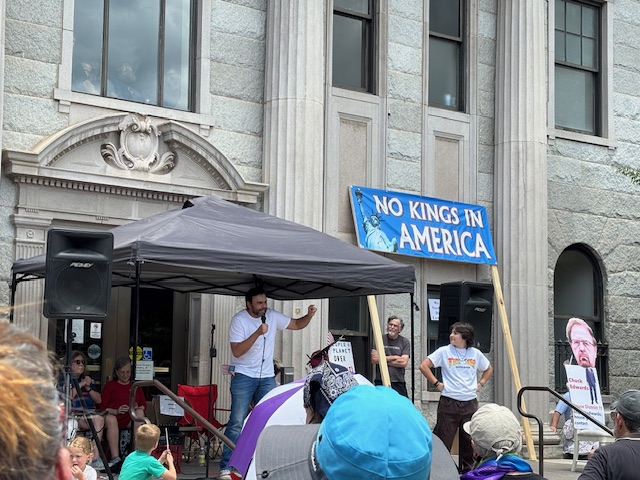
Andrew Aydin speaking at the Waynesville, NC, courthouse in the “presence” of invited but absent North Carolina Republican Representative Chuck Edwards to the right.

The author Andrew Aydin was spotted Saturday, June 14th at the “No Kings” rally in Waynesville, North Carolina, where he was the final speaker at its protest against authoritarianism. He will also be speaking this Tuesday, June 17th,  at 6 p.m. at the Pigeon Community Cultural Center in Waynesville, NC, to introduce his Appalachia Comics Project

No Kings rally at the Waynesville, NC, courthouse June 14, 2025 –
photo courtesy of Becky Johnson, The Mountaineer

A crowd of 1500-2,200 people – in a town of less than 11,000 residents and in a county (Haywood County) of less than 65,000 – gathered at the Waynesville courthouse at noon. Adjacent towns of Sylva, Asheville, Brevard, Hendersonville, and Bryson City held concurrent rallies.  It was part of a day of about 2000 protests nationwide organized by No Kings; Waynesville’s protest was spearheaded by Hands Off! Hendersonville, which is affiliated with Indivisible. The king in the room (that is, at the courthouse) was the Trump Administration. No Kings website states: “They’ve defied our courts, deported Americans, disappeared people off the streets, attacked our civil rights, and slashed our services.” The protests coincided with the Administration’s $40-million military parade on Flag Day through the streets of Washington DC.

Signs at Waynesville No Kings rally, June 14, 2025

Aydin is co-author, with the late Georgia Congressman John Lewis and illustrator Nate Powell, of the March graphic memoir series on the civil rights movement. Book 3 of the series won the National Book Award in 2016 in the category of Young People’s Literature. Aydin, who served on John Lewis’s staff from 2007 to 2020, is now working on a series called Run about Lewis’s political career.

Aydin was fired up about misinformation about lack of federal aid for survivors of Hurricane Helene in Western North Carolina, which killed 107 people. The communities in Edneyville, Bat Cave, and Chimney Rock, near where he lives, he said, pulled together after the hurricane and benefitted from the support of the federal government, yet outside agitators spread the misinformation that they were getting no help at all:

Aydin’s anger motivated his new Appalachia Comic Project, which aims to capture authentic stories of Hurricane Helene survivors and disseminate them in comic-book form. According to Aydin, stories have unique power to assert values, counter lies, reclaim authenticity, and stand one’s ground. 

Signs at Waynesville No Kings rally, June 14, 2025

Aydin’s speech followed that of Stephen Wall, who read a letter by an anonymous civil service worker who had been fired; Lisa Leatherwood, who spoke of the expected Medicaid cuts to Haywood residents including those at the Silver Bluff Village skilled nursing home that she use to own; and Carolyn Carlson, former president of the Society of Professional Journalists, who warned that gag orders are compromising freedom of the press nationwide. 

Signs at Waynesville No Kings rally, June 14, 2025

It was from Aydin that I heard about the political assassination of Minnesota Representative Melissa Hortman earlier that day, and the news unsettled me. Attendees trying to tune into the speeches also had to listen to a convoys of trucks with large flags spilling out the back driving down Main Street behind them, gunning engines, and attempting to drown out the speeches. We were instructed to counter any conflict with the chant “Bless Your Hearts.” I was near the stage and couldn’t hear specifically what the crowds bordering the street were chanting, but the relentless loud honking and gunning of engines was hard to ignore. Simultaneously a daylong “Spirit of America” fundraising event was being held by the Haywood County Republican Party in nearby Maggie Valley.

Sign at Waynesville No Kings rally, June 14, 2025

I was most impressed with Aydin’s articulation of how the political right is changing the meaning of language as we’ve known it. It is not hard to think of examples of such doublespeak. For me what comes to mind is the word “censorship.” To the right, censorship has come to mean objecting to a certain word or phrase and pressuring people to use another word or phrase (i.e., political correctness). Yet the actual definition of the word is “the action of preventing part or the whole of a book, movie, work of art, document, or other kind of communication from being seen or made available to the public, because it is considered to be offensive or harmful, or because it contains information that someone wishes to keep secret, often for political reasons.” To the left, censorship maintains its actual definition and means removing books as is being done in public school libraries so that no one can gain access to those writers, their stories and ideas; removing an entire field of knowledge, sociology, from the curriculum as was done at West Point Military Academy last semester; or forcing all publishers of science textbooks sold in Florida to remove the words “climate change” in an effort to suppress reality and the written record. 

Andrew Aydin was a clever choice for a speaker on a day of national protests. His presence alluded to the marches on Selma, Alabama, in 1965 to secure voter rights for a vulnerable part of the population on a day when soldiers and tanks were being mobilized in Washington to show dominance and when the Marines and National Guard were watc on in Los Angeles. Aydin closed this way:

There is no sound more powerful than the marching feet of a determined people. So join us and let’s march, and take care of one another, and fight back. Because we are all we have. We are each others’ brothers and we are each others’ keepers and we are each others’ sisters and together we will build a more perfect union and build that city on the hill.

Revelation

Flannery O’Connor’s fervid following

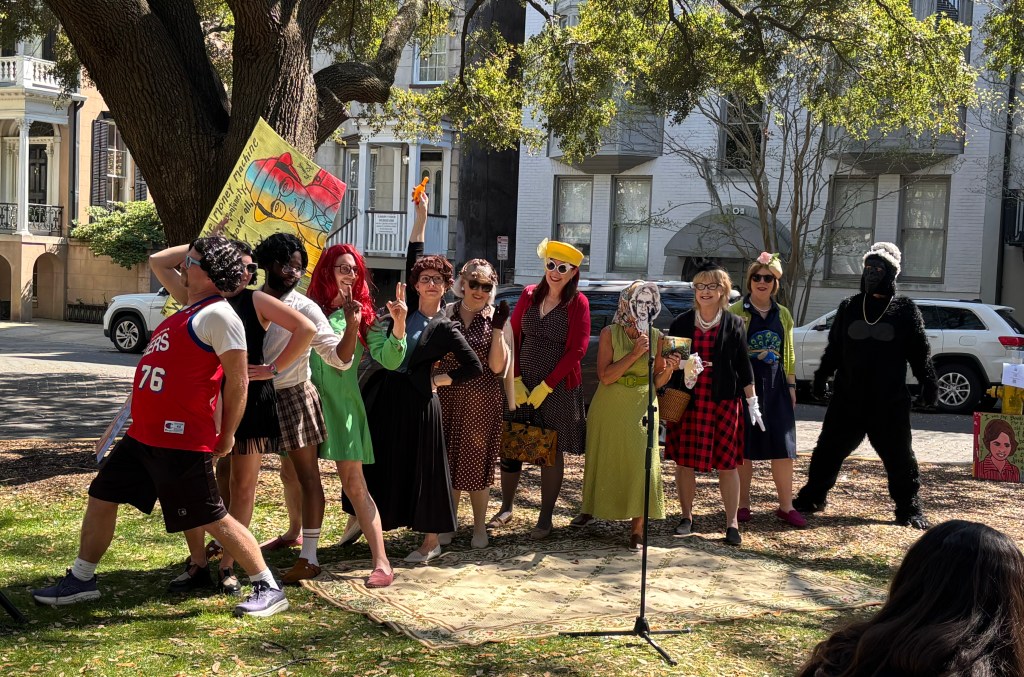
The Flannery O’Connor look-alike contest in Lafayette Square, Savannah, Georgia, on March 23, 2025. Denise Flojo (the lady at center in brown polka-dotted dress) was declared the winner, beating out the “Flannery O’Connor Spice Girls” quintet to the left. 

Flannery O’Connor (1925-1964) had her biggest-ever annual birthday celebration in Savannah, Georgia, last weekend, on the occasion of her 100th birthday. The Southern Gothic writer from Savannah was feted with three days of events, starting with soirées on Friday night and ending with a New Orleans-style procession through Lafayette Square led by Savannah’s Sweet Thunder Band late Sunday afternoon. It was a blast.

Flannery has always been an outsider, a Southerner in America, a devout Catholic in the Protestant South, a lupus patient walking with lofstrand crutches, and an unconventional female artist embracing the grotesque as a vehicle to convey the sublime. She explained her literary approach as a devout Catholic in “The Fiction Writer and His Country”: “to the hard of hearing you shout, and for the almost-blind you draw large and startling figures.” Academia never knew quite what to do with her and still doesn’t, especially considering her use of the n-word in her 1950s and 60s-era texts, as a person rooted in her geopolitical milieu. When I taught “Everything That Rises Must Converge” in the Honors College at Georgia State University recently, my students did not know who Flannery was. Yet it is clear from the weekend in Savannah that her following is alive and well  – and growing – among seekers and artists.   

Lafayette Square, Savannah, Georgia, the center of the Flannery O’Connor’s world until she was age 13.

Flannery O’Connor’s short stories juxtapose the grotesque in everyday circumstances against the ultimate mystery of human existence within a divine context. Her sentences astound with their sheer unpredictability, the journey from the beginning to the end of a sentence almost a short story in itself. Consider this sentence from “The Life You Save May Be Your Own” when the tramp from Tarwater, Tennessee, Tom T. Shiflet, takes out a pack of gum: “He offered the old woman a piece but she only raised her upper lip to indicate she had no teeth.”  Or this one, later, after he lit a match for his cigarette against his shoe: “He held the burning match as if he were studying the mystery of flame while it traveled dangerously toward his skin.” We sense the epic, weighty, eternal dimension behind every word. Wake up!, the sentences seem to say. The destiny of your soul and the destiny of the world are at stake. 

In her essay “The Grotesque in Southern Fiction,” Flannery wrote: 

Whenever I’m asked why Southern writers particularly have a penchant for writing about freaks, I say it is because we are still able to recognize one. To be able to recognize a freak, you have to have some conception of the whole man, and in the South the general conception of man is still, in the main, theological.

The Friday night soirées took place at two different historic homes in Savannah, the Flannery O’Connor Childhood Home Museum on Lafayette Square and the Davenport House garden near Columbia Square. Attendees wore name tags noting their favorite work by O’Connor (among them “Revelation,” “Good Country People,” “Parker’s Back,” “A Temple of the Holy Ghost,” and Wise Blood), which prompted immediate conversation. I had interesting conversations with many members of the O’Connor Home Board of Directors, especially on the question of Why Flannery? Why now?

Bill Broker, a lawyer who comes to Flannery through his Catholicism, told me about the outpouring of Flannery-inspired music by Bruce Springsteen, U2, Colin Cutler, and many other musicians. Nancy Fullbright pointed to Ethan Hawke’s 2023 film Wildcat staring Maya Hawke and Laura Linney as popularizing some of her stories. Board president-elect Lee Griffith, professor of writing at Savannah College of Art and Design (SCAD), characterized Flannery as still contemporary in her exploration of many issues such as race and disability. Bonaventure Cemetery Director Sam Beetler II expressed Flannery’s quintessentially American quest to figure out her place (as a southerner, as a Catholic, etc.) within the larger world. Damon Mullins, executive director of the Ogeechee Riverkeeper, who was also in attendance, suggested that Flannery’s sheer weirdness and the weirdness of the annual birthday party in Lafayette Square was something that made Savannahians proud. 

The Flannery O’Connor Childhood Home Museum on Lafayette Square. “Flannery oconnor home” by JRempel is licensed under CC BY-SA 3.0.

Festivities continued the next day with a tour of Lafayette Ward, the neighborhood surrounding Lafayette Square, which is grounded by The Cathedral Basilica of St. John the Baptist. From their modest house along this square, the O’Connors attended the cathedral daily. Our knowledgeable guide, board member Roger Smith, further illuminated Flannery’s judgment – she wrote with compassion, he said, for those around her who struggled to navigate life without Catholic doctrine. 

Tours of the house and cathedral were also held throughout the day. A telling image from Flannery’s childhood home is her baby bassinette (“kiddie koop”) situated directly under the Cathedral’s spire. 

Flannery’s “Kiddie Koop” from Sears Roebuck, a collapsible baby bed and playpen (you can move platform up and down) on wheels, covered with mosquito netting, in her parents’ bedroom at the Flannery O’Connor Childhood Home Museum, under the spire of the cathedral basilica of St John the Baptist in Lafayette Square, Savannah.

This detail was pointed out by the wonderfully engaging executive director of the Flannery O’Connor Childhood Home Museum, Janie Bragg, on her tour of the house, where Flannery lived until she was 13. Tours of the Cathedral were also provided throughout the day. The events on Saturday culminated in an evening concert fundraiser at Service Brewing near the Savannah River, where Colin Cutler and the Hot Pepper Jam Band performed songs from their Flannery-inspired album Tarwater.

Flannery O’Connor Childhood Home Museum Executive Director Janie Bragg introducing musician Colin Cutler and the Hot Pepper Jam Band.

Over sour beers while listening to Cutler’s “Bad Man’s Easy” among other songs, we discussed a 1959 recording of Flannery O’Connor reading “A Good Man is Hard to Find,” a thoroughly delightful rendition if you can decipher it (that’s a challenge). In this, one of her most famous stories, a grandmother, her son and his wife and children encounter the escaped criminal The Misfit on the backroads of Georgia. 

Colin Cutler and the Red Pepper Jam playing their Flannery O’Connor-inspired album Tarwater at Service Brewing Inc., Savannah, Georgia, on March 22, 2025.

The party picked up again on Sunday at noon back on Lafayette Square, now strewn with an eye-catching display of paintings by the Savannah artist Panhandle Slim who has long been inspired by Flannery O’Connor. Slim paints on wooden placards, in the long tradition of Georgia outsider artists, faces and words of famous people. A number of placards were of Flannery O’Connor. On the other side of the square, local authors sold their latest books.

Wooden board paintings by Savannah-based artist Panhandle Slim, March 23, 2025.

Father Drew Larkin from The Cathedral Basilica of St. John the Baptist offered a formal blessing. Entertainment included Irish step dancing, improvised opera by singers from Moon River Opera, the Flannery O’Connor look-alike contest, and a performance by Sweet Thunder Band. 

Sweet Thunder Band performs in Lafayette Square, Savannah, March 23, 2025. 

At the end of the day, Sweet Thunder Band spun out into the square and gathered people behind them in a dramatic sendoff. By that time, the large sheet cake had been eaten and new friends were saying goodbye.

Flannery’s 100th birthday procession in Lafayette Square, Savannah, March 23, 2025.

Only a few days after this event in Savannah, festivities shifted north to Georgia College and State University in Milledgeville which now owns the Cline house where the O’Connors moved when Flannery was 14 and the family farm “Andalusia” where she lived with her lupus and peacocks in the last years of her life. The university unveiled a set of paintings by Flannery that never been on display before and that can be seen at Andalusia Interpretive Center through December 22, 2025. Their 100th birthday celebration of Flannery will take place on March 29.

Janie Bragg reflects on Flannery’s growing reach:

As things are being publicized, we’re having a Flannery moment. A good example is the art. The next example is her prayer journal that was published in 2013…so we are getting more and more not only books about Flannery O’Connor but of Flannery’s writing. Dear Regina was just published in 2023. Those are her letters to her mother…She’s so much more accessible now than she was before. And then that has all spurred things in the zeitgeist like Wildcat – that’s huge. Wildcat, not only is it a movie, so people who don’t like to read necessarily or don’t think of themselves as readers can come to Flannery through a different medium, but Ethan Hawke and his daughter Maya Hawke have a whole other audience than Flannery has, so they are bringing in all of these new people, these younger people, and that is very exciting. So I think her reach is spreading now in a way that it hadn’t before.

New research into the O’Connor’s black domestic help and farmhands at Andalusia will add other dimensions to Flannery’s complex story and milieu.

Father Drew Larkin from The Cathedral Basilica of St. John the Baptist blessing Flannery O’Connor’s 100th birthday celebration in Savannah, March 23, 2025.

The Flannery O’Connor event is a great example of living, breathing literature.  Come next March to enter the conversation and celebrate at Flannery’s 101st party.

Meridian: 6.(a) a place or situation with its own distinctive character; (b) a distinctive character

John Lewis’s funeral and the civil rights novel dedicated to him

John Lewis Memorial 1A
Neighborhood John Lewis memorial, Atlanta

(Updated March 2025)

I was just finishing John Lewis’s three-book graphic memoir March when on July 17th John Lewis died. The representative from Georgia’s 5th Congressional District (Atlanta; ours) for 33 years was expected to die of pancreatic cancer but he had also just been elected to a 16th term starting in January 2021 and so the timetable was unclear. Memorials sprung up instantly on our street, made out of still warm election signs. One was draped in black tulle with sunflower vase and flag offerings. Another featured a metal rooster, referencing the chickens Lewis would preach to growing up in Troy, Alabama.

John Lewis memorial 2
Neighborhood John Lewis memorial, Atlanta

Reading March prepared me for Rev. James Lawson who, among many, eulogized Lewis at Ebenezer Baptist Church (“America’s Freedom Church” under Reverend Raphael Warnock) on July 30. Book 1 champions Lawson, former director of the Congress of Racial Equality and leader of the first workshop on nonviolence that John Lewis took in Nashville, TN, in 1958. Lewis impressed on the reader the depth of the non-violence philosophy and the rigor of its practice, with students taking turns trying to “break” each other into violence and steadfastly resisting. The training prepared them to face violence without returning it when forcing desegregation of lunch counters, fast food restaurants, cafeterias, and bus lines throughout the south. It prepared Lewis ultimately for Bloody Sunday in 1965, when he and Hosea Williams led the march across the Edmund Pettus Bridge in Selma, Alabama, towards Montgomery demanding the legal right for black people to vote without obstruction and Lewis, beaten, nearly became one of the casualties on the way to the Voting Rights Act.

Jim Lawson teachings 2
John Lewis, Andrew Aydin, and Nate Powell, March: Book One. Marietta: Top Shelf Productions, 2013. Page 77.

“John Lewis called what we did between 1953 and 1973 the Non-Violent Movement of America – not the CRM [Civil Rights Movement]. I think we need to get the story straight because words are powerful. History must be written in such a fashion that it lifts up truly the spirit of the John Lewises of the world.” – James Lawson, eulogizing John Lewis

However personal Lewis’s funeral was, it was also, from its beginning to its culmination with President Obama’s impassioned address, also a plea, alluding to those who died to win the vote in the 50s and 60s, to use the vote in the 2020 national election, the vote being the ultimate non-violent action. As reported by the Pew Research Center, the vote was underused in the 2016 election, in part because of voter list purging and other forms of voter suppression.

MERIDIAN – the main character of Alice Walker’s 1979 novel of the same name, which Walker dedicated to “John Lewis the unsung” years before he was first elected to Congress – marched for justice, got people to register to vote, and canvassed to get people to the polls. Meridian is about a young black activist finding her way in the Movement in the period after Lewis stepped down as chairman of the Student Nonviolent Coordinating Committee, after alternative philosophies of violence entered the mix, and after a number of its leaders were killed. Much of the novel is set in Atlanta, where Meridian goes to college, devoting herself to marches for justice and voter registration drives across the south. Some of the best chapters near the end are vignettes of Meridian and her companion Truman interceding in the lives of  hard-to-reach black folks to register them to vote; nothing is straightforward when poverty and sickness are in the way.

John Lewis memorial
“Don’t Give Up! Don’t Give In! Keep the Faith!”by Marc Merlin is licensed under CC BY-NC-SA 2.0

Walker’s text leaps off the page, fresh and bright, despite being published 41 years ago. Meridian herself moves with the fits and starts of a young determined person, charging forward and then collapsing (epilepsy?), asking questions about how much she can give and if what she can give is enough. The pressure to embrace violence comes up a lot: “Is there no place in a revolution for a person who cannot kill?” she asks. Truman turns cynical in the chapter “Questions,” doubting that much was left of the Movement: “The leaders were killed, the restless young were bought off with anti-poverty jobs, and the clothing styles of the poor were copied by Seventh Avenue. And you know how many middle-class white girls from Brooklyn started wearing kinky hair.” Meridian, in contrast, is not cynical. She keeps moving to apply pressure for change, even if she doesn’t have all the answers.

This sound clip from the chapter “Camara” read by Atlanta actor and edutainer Charlotte Ford of Charly Ford Entertains, highlights Meridian’s tortuous perseverance:

The novel explores the theme of social justice as fashion, particularly directed at white sympathizers and especially the character Lynne Rabinowitz. Lynne is a white northerner journeying south to join the Movement, romanticizing it: “To Lynne, the black people of the South were Art.” Lynne and Truman take up as an interracial couple, marry, have a child, deteriorate, all the while intersecting Meridian’s life, circling around her, trying to draw her into their dramas and provoke jealousies, but this plot seems there to highlight Meridian’s contrasting focus. This kind of distraction fails to break her, and she marches on.

Jim Lawson teachings
John Lewis, Andrew Aydin, and Nate Powell, March: Book One. Marietta: Top Shelf Productions, 2013. Page 82.

As a white person, it is interesting to read about Lynne’s descent from middle class suburbia to welfare poverty and exile, deeper into the raw and real (which she doesn’t renounce), becoming pathetic and ugly. It raises questions about white participation in the ongoing march for social justice and what real risks one is willing to take. To what degree is marching fashion and to what degree is it backed by staying power?

I ponder this because of a cherished photo of John Lewis and my husband on the day of the 2017 solar eclipse. Lewis was free with photos, happy to oblige with his staff. And now is a good time to ask: What exactly does this photo represent? Is it fashion, a wish to be seen as being on the right side of history? Or is it a display of a deeper commitment as an ally? John Lewis was an accessible entry point, perhaps offering white people a means to acknowledge societal guilt and release some of it, or to diffuse racial tension that so often marks our lives here.

Les and John Lewis 8-21-2017 solar eclipse
Leslie Leighton and John Lewis, with permission of the former

But I think it was something deeper, having myself encountered John Lewis on a path once and experiencing the thing about him that people wanted to touch. Here was a person who had done the unthinkable, moved into violence without reacting, with lifelong damage to his body, persisting over decades of public service to speak out and push for change. Wanting to touch him could have been a primitive attempt to become infected with some bit of that same courage, hoping to have it pass from his being into ours. With the tangible being of John Lewis gone, we have to do it the harder way ourselves.

So I pledge to serve at least one get-out-the-vote phone shift (and I hope more) for the coming national election, highlighting the absentee or vote-by-mail process as a safe option during the pandemic. Although applications were mailed automatically during the Georgia primary election, this will not be the case again (unless you’re aged 65 years or older and checked the right box), making it very confusing. I’m looking forward to my training to find out all the nuances of application and vote casting. Remember the requirement in the Georgia primary to place the absentee ballot inside the “inner envelope,” the one that did not exist?  (yes, it was supposed to be wrapped in that folded piece of paper, which you probably threw away, instead). Remember voters purged from the rolls when signatures didn’t match their IDs? I’ve learned since that your driver’s license signature is the key to that match. I’ve learned that you can check your voter status, ensuring that you are still active, and apply for an absentee ballot through Georgia My Voter. Through this site you can also monitor potential irregularities and keep informed about any runoff dates and deadlines. Ignore any information on the Internet that tells you it’s too late to request the absentee ballot. March on.

Addendum, March 2025: John Lewis left behind the John and Lillian Miles Lewis Foundation in Atlanta, which is active today in supporting voter rights including high school voter registration, civic engagement, and youth civil rights tours. Invoking Lewis’s famous lines, “We may not have chosen the time, but
the time has chosen us” and “Get out there and push, and stand up, and speak out,
and get in the way the same way my generation got in the way.
Get into trouble. Good trouble. Necessary trouble,” the foundation invites posts stories of “good troublemakers” today.

Love in the time of coronavirus

Timely contents of a Little Free Library

Violin 4
The music goes on

(Updated March 2025)

Coronatime, life during COVID-19 pandemic, is transforming everything, multiplying the many forms of love. We are clinging to those we take for granted. Many of us are reaching out to long-lost friends and family members. Across the world people are singing in solidarity from their confined apartments in adjacent buildings. Others are cheering for exhausted healthcare workers who are risking everything. Healthcare workers are applauding patients coming off ventilators. Citizens are appreciating all the suppliers along the food chain. Some are venturing to shop for the frail or quarantined. Over and over we are seeing the meme of love expressed through window panes. We are dreading the grieving love of passing life. At the same time, people are falling in love. From isolation to the dance of facial masks in public space, the thrill of fear and danger, it’s a Mardi Gras unlike any other. Symptoms are timeless: fever, shortness of breath, and a nervous cough. Continue reading Love in the time of coronavirus

The never sufficiently praised Don Quixote of La Mancha

An egomaniac on the loose in the US and Spain

Head of Don Quixote
“Don Quixote head” by sanzibar is licensed under CC BY-NC-SA 2.0

(Updated March 2025)

Thank you Salman Rushdie for finally getting me to read Don Quixote (1615) – Edith Grossman’s 2003 translation in particular. Your New Yorker story “The Little King” and the recently published novel Quichotte seduced me in by showcasing Atlanta and by inviting readers to compare Cervantes’ classic to contemporary times. Continue reading The never sufficiently praised Don Quixote of La Mancha

A Californian in Atlanta

Georgia’s “heartbeat” bill evokes Joan Didion’s Play It as It Lays (1970)

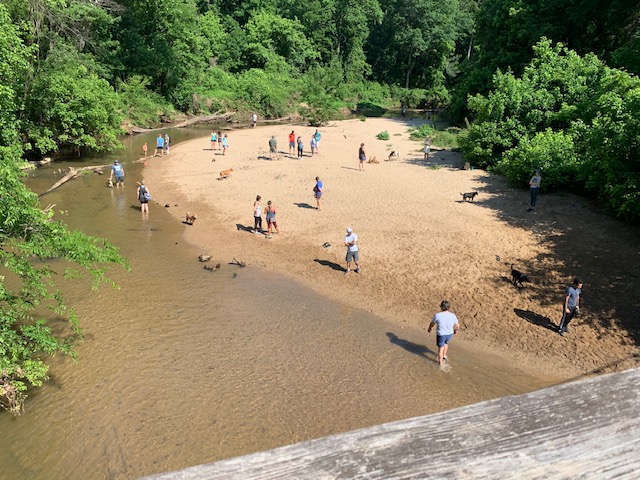
Beach by South Fork Peachtree Creek, Morningside Nature Preserve Atlanta
Beach along the South Fork of Peachtree Creek, Morningside Nature Preserve, Atlanta

(Updated March 2025)

After living in Atlanta for 14 years, I remain convinced that as states go, Georgia and California are about as far apart, physically and culturally, as you can get. The sweltering humidity of Hotlanta in July is completely unknown in Fog City where heat is dry, plunges at night, and reappears in the morning only after the fog lifts. The ocean is a long four-and a half hour drive away from Atlanta compared with minutes away in my native Bay Area, though I’ve recently discovered the sand beaches hidden along our copious creeks. The Golden State has “Cal” (University of California at Berkeley), the ghost of hippies past, while the Peach State has “UGA” (University of Georgia, Athens) where students even today actually wear what appear to be Chanel dresses to football games. California speak may be vague, dude, but Georgia speak is intentionally indirect and veiled, bless your hearts. California has Hollywood, but Georgia has … Hollywood of the South. Finally! One point of state-to-state connection. Continue reading A Californian in Atlanta

Riotous noon-day sun of the June-day long

Sidney Lanier’s The Marshes of Glynn comes alive in music

1
The Meridian Chorale performing in Southern Folk Passion, with Brenda Bynum on April 14, 2019 (photo courtesy of Meridian Herald)

(Updated March 2025)

I owe my budding awareness of the musician poet Sidney Lanier entirely to Meridian Herald’s Southern Folk Passion this past Palm Sunday at the Church at Ponce and Highland. But for stumbling upon Lanier on the group’s website before the concert, I might have always assumed that Lake Lanier and the other Lanier monikers around Atlanta were named for a great engineer or politician rather than a bard. Knowing that they are named after a poet laureate from Georgia, one who was commissioned as a southerner to write lyrics (along with Dudley Buck, a northerner, to write the music) for the cantata for the 100th anniversary of the United States in 1876, deepens my understanding of Georgia as a literary place.  Continue reading Riotous noon-day sun of the June-day long

Not like one of the family

Seeing and hearing black nannies

Robert Frank Charleston South Carolina
Robert Frank, “Charleston, South Carolina,” from Framing Shadows exhibit, photo of a photo

(Updated March 2025)

Kimberly Wallace-Sanders’ exhibit Framing Shadows at Emory University’s Robert W. Woodruff Library features 22 photos of African American nannies of white children from the 1840s to the 1920s, a family photo type found during these years in the eastern United States. It also displays novels that feature the mammy or nanny-child relationship such as Gone with the Wind, which Dr. Wallace-Sanders has written about in Mammy: A Century of Race, Gender, and Southern Memory. The juxtaposition shows a progression in Dr. Wallace-Sanders scholarship from the fictive mammy character in narratives, images, and artifacts to the real African American domestic servant taking care of white children in historical photos and biographical accounts. The exhibit previews her upcoming book on this work Nannies, Mammies, and Love Slaves: Portraits of Black Women Taking Care of White Children 1850-1950. Continue reading Not like one of the family